Lessons · Tue Oct 20, 2026 · Life Preparation
The Importance of Obedience in Bringing Others to Christ
John 14:15, 21; Daniel 6:3, 18–28; Mosiah 18:9; 1 Nephi 3:7; Doctrine and Covenants 130:20–21
The principle
Personal righteousness and obedience qualify us to represent the Savior and to have the companionship of His Spirit. People who will never read the scriptures will read us.
What the lesson is for
Let students find out that somebody is already reading a name off their behaviour, and leave having named the one habit of theirs that is currently teaching people something false about the Savior.
Personal study, first ten minutes
Daniel 6:1–10, 18–28
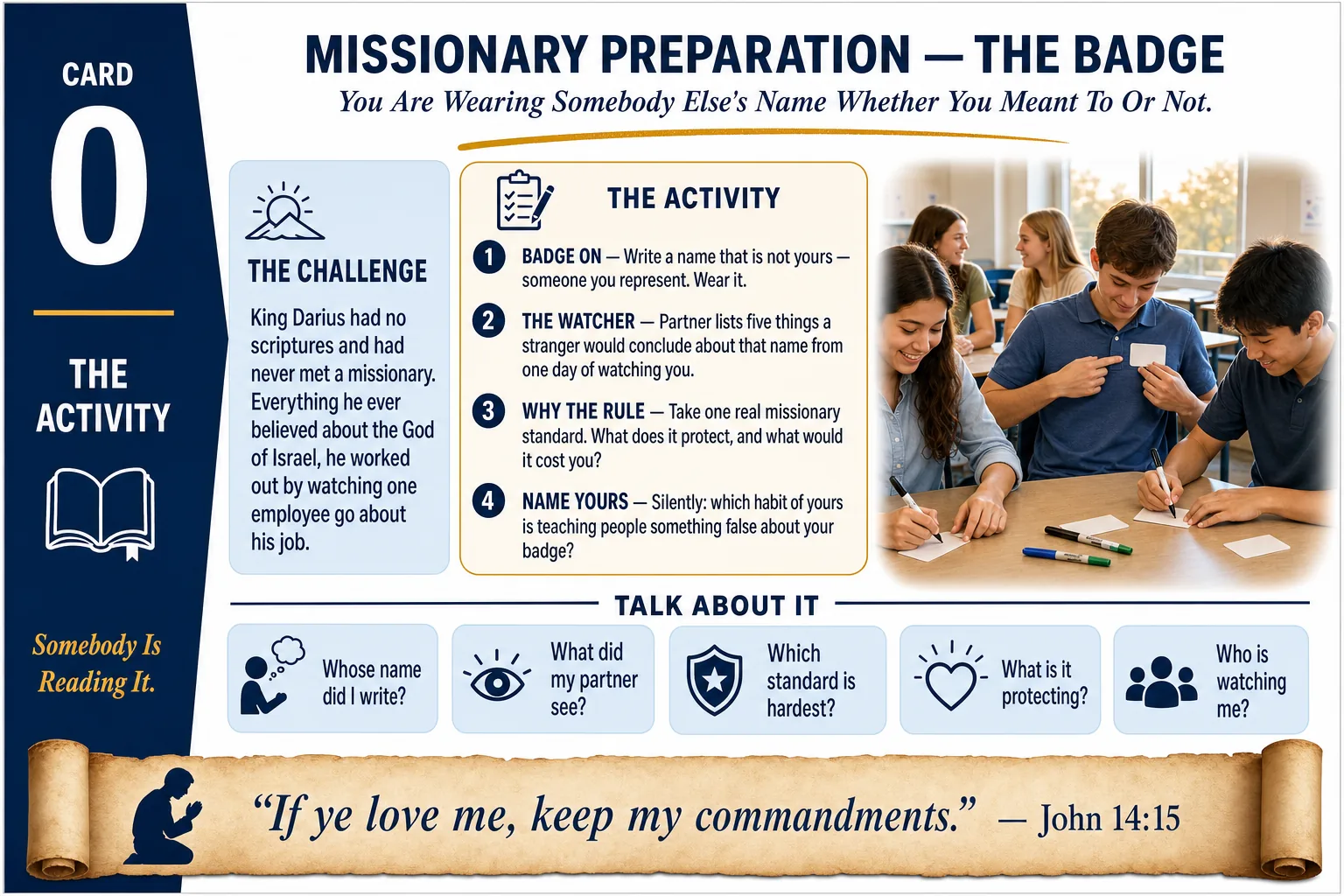
King Darius was not a believer and had no scriptures. Everything he ever learned about the God of Israel, he learned by watching one employee. Read verse 3 and find what Darius had noticed about Daniel before any of the trouble started, then read 18 to 28 and find what he ended up declaring to his whole empire.
The deck
Click any card to see it full size.
Teacher notes
Supplies, board work and timing. Never printed on the cards.
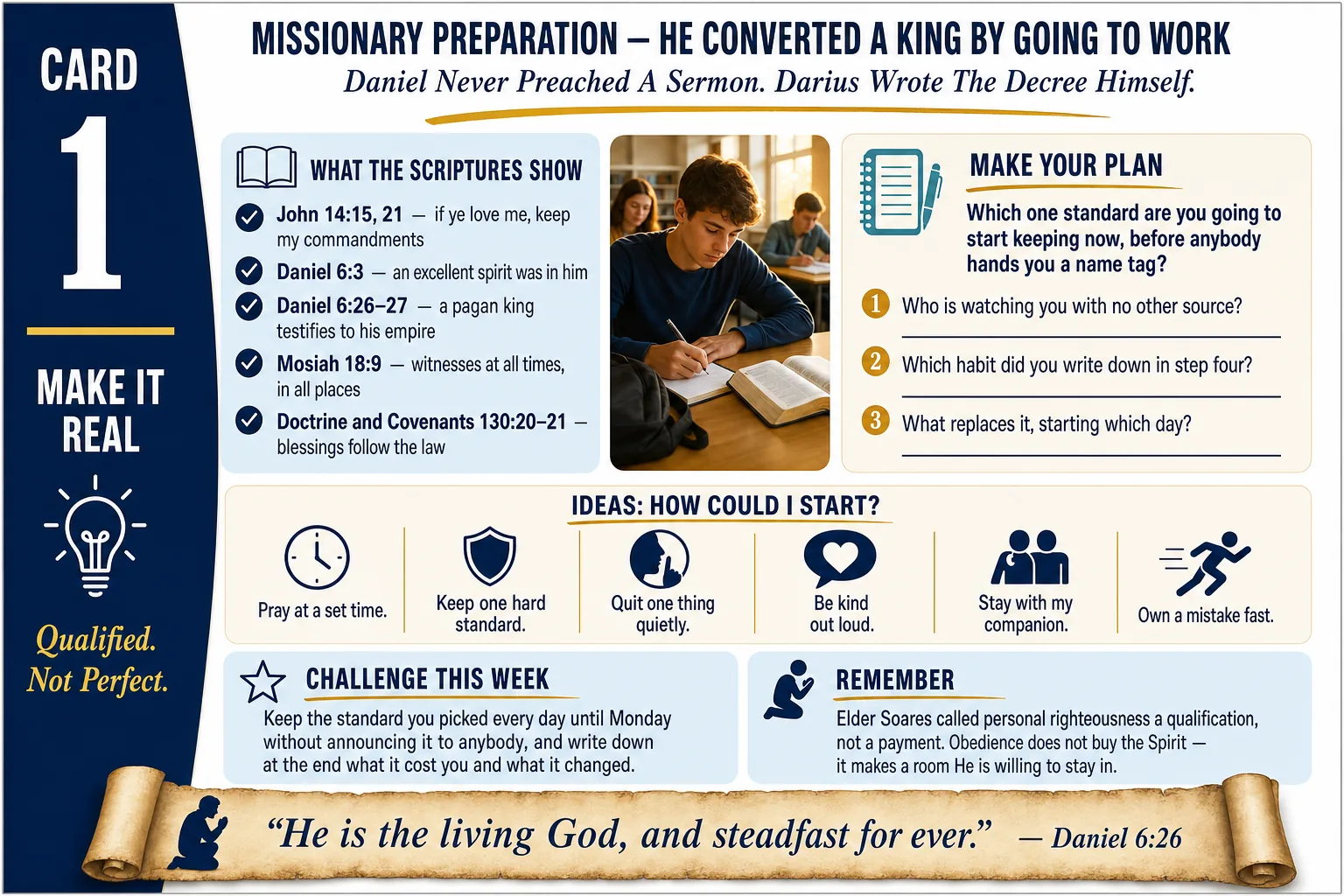
SUPPLIES, AND THEY ARE CHEAP BUT NOT OPTIONAL: a sheet of blank adhesive name badges — one per student plus spares — and enough markers to go round. Masking tape and a marker works if the badges do not happen. Also print the missionary standards strips: cut up Section 3 of 'Missionary Standards for Disciples of Jesus Christ' so each pair gets one real standard on a slip of paper. Do the cutting the night before; you will not do it at 6:10. THIS IS A DOING DAY — two cards, one activity, and the room should be loud in the middle of it. Do not turn it into a reading lesson about rules. THE ACTIVITY IS 'THE BADGE' AND THE ORDER MATTERS. Step one, everybody writes a name on a badge that is not their own — somebody or something they represent. Family surname, the team, the Church, the Savior. Let them choose; the choice itself tells you something and you should notice who writes what. Step two, in pairs, two minutes: your partner lists five things a stranger could conclude about the name on your badge just from watching you through one ordinary Tuesday. They must be specific and they are allowed to be unflattering. This is the step that does the work and it will get quiet about ninety seconds in. Step three, hand each pair one real missionary standard and have them work out what it actually protects and what it would cost them to keep it — not whether they like it. Step four is personal and silent: write the one habit of yours that is currently teaching people something false about the name on your badge. Nobody reads step four out loud, and say so before they start or you will get jokes instead of answers. THE STANDARDS WILL GET PUSHBACK AND THAT IS FINE. Always stay with your companion. No television, movies or video games. Physical contact limited to a handshake. The manual asks straight out why these would be hard AND why they would matter, and both halves are needed — a class that only answers the first half learns that rules are a burden you survive, and a class that only answers the second learns to pretend. Ask both. Let somebody say a standard seems extreme and then ask what it is protecting; that conversation is the lesson. ELDER SOARES IS THE DOCTRINE, not a decoration: 'Personal righteousness is one of the most important qualifications to represent the Savior before the world. It also qualifies us to have the companionship of the Spirit of the Lord with us. ... If we choose not to be obedient, we will not be able to represent the Savior accordingly, nor will we have the Spirit of the Lord with us' (Scott Tayler, 'Obedience Is Critical for Missionaries to Fulfill Their Responsibilities, Elder Soares Teaches,' newsroom.ChurchofJesusChrist.org, Mar. 29, 2021). Qualifications is the word to underline. Obedience is not the price of the Spirit, it is what makes room for Him. DANIEL AND DARIUS IS THE BEST STORY THE MANUAL HAS FOR THIS and the class studied Daniel 6 back in Lesson 145, so it should come back fast. The thing to point at: Darius was a pagan king with no scriptures and no missionaries. His entire knowledge of the God of Israel came from watching how one of his administrators behaved, and it was enough that he published a decree about Him to the whole realm. Daniel converted a king by going to work and praying three times a day. Ask who in their life is in Darius's position — watching, with no other source. THE TALK OUTLINE IS THE MANUAL'S CLOSE and it is good, but it will not fit in thirty minutes with the badge activity. Pick one: either run the activity properly and put the plan on card 1, or cut step three and build outlines. I would keep the activity. If a student wants to make the outline, send them home with the handout; the manual suggests teaching it to a family member and that is worth more than performing it for the class. OBEDIENCE IS NOT THE SAME AS EARNING, and after Wednesday's lesson this will matter: Jeremiah 3 says He is merciful and will heal the backsliding, and nothing today reverses that. The badge is not a worthiness audit. Keep the frame on representing rather than qualifying for love — John 14:15 is 'if ye love me,' which puts the love first and the keeping second. THEME LINK, AND BE PRECISE: this is the climb, panel one — faith plus works, and works are not the payment. Free is not the same as easy. Obedience never bought the water; it is the difference between carrying a full cup down the hill to somebody and arriving with an empty one. THE WEEK: Monday He called you and filled your mouth, today you find out people are reading you, Wednesday you go back to the fountain yourself, Thursday you go get somebody. TIMING: badges and step one three minutes, the watcher four, standards strips eight, step four three minutes of silence, card 1 and the plan eight, journals at 7:05. If you are behind, cut the standards strips to one shared standard discussed as a class.
Journal prompt
The last five minutes. Card 1 hands into this.
Write the name you put on your badge, and the five things your partner said a stranger could conclude about it from watching you for one day. Then write the habit from step four — the one teaching people something false — and what you are replacing it with. Finish with the name of the one person in your life who is in King Darius's position: watching you, with no other source.