The year's theme
The parable of the water
A hiker, a desert, and a water station on a hill. Three pictures that hold the whole year together — the climb, the drink, and the telling — and four more that name what stops people: pride, judgment, not for me, and the other path.
Every year needs one image the class can be sent back to. This is ours. It is not scripture and it is not a Church production — it is a teacher-made parable, drawn for this class, and it exists because it says in three pictures what the Old Testament has been saying to us all autumn.
The scripture underneath it is two verses of Isaiah:
Therefore with joy shall ye draw water out of the wells of salvation. And in that day shall ye say, Praise the Lord, call upon his name, declare his doings among the people, make mention that his name is exalted. Isaiah 12:3–4
Draw the water. Then tell people. That is the parable, and that is the year.
One — the climb
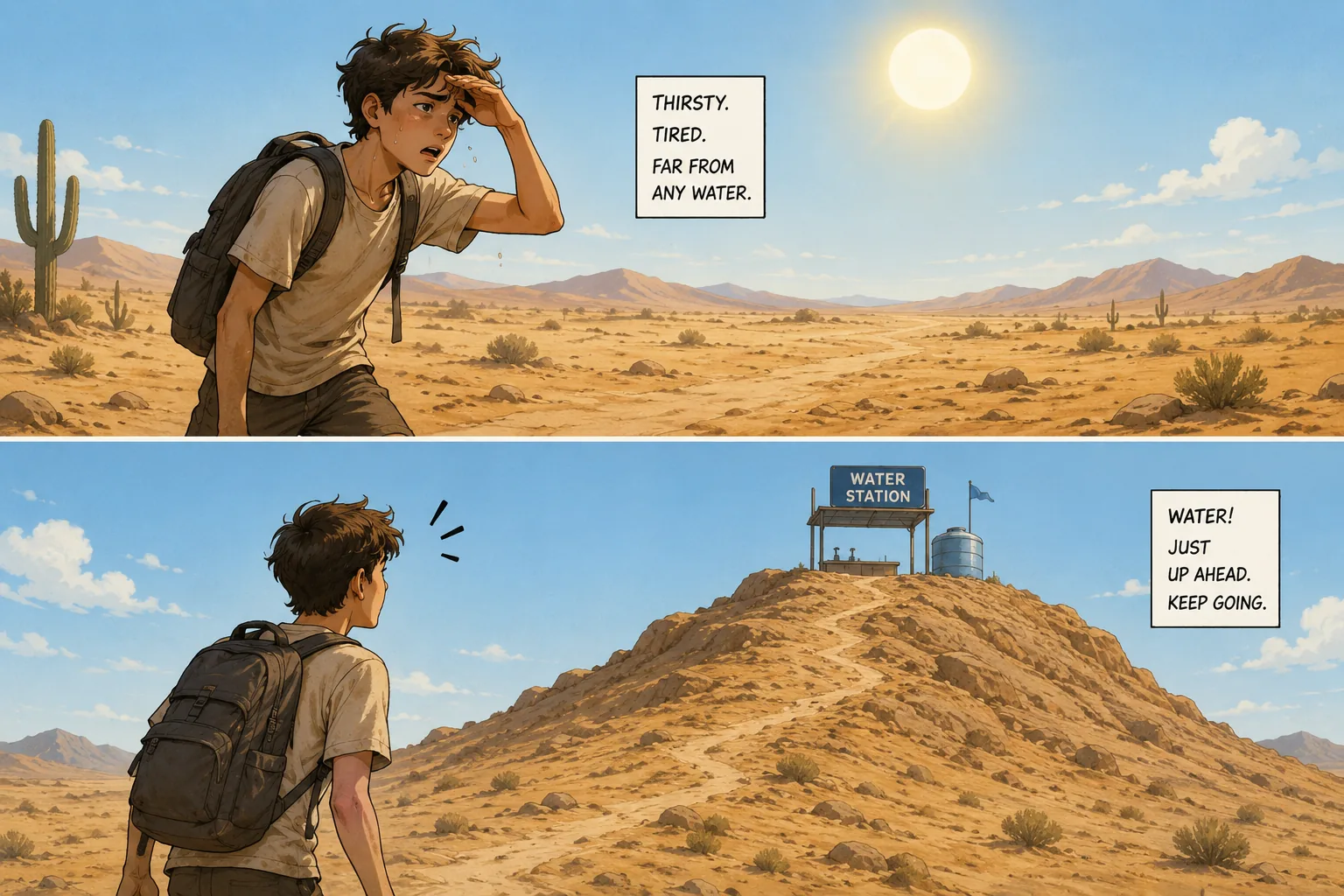
Look at what the first panel actually asks of him. The water station is real, and it is uphill, and he is already tired. To get there he needs two things, and neither one alone is enough.
He has to believe the water is up there. He cannot see the tap from where he is standing. He can see a sign and a shape on a ridge, and he has to trust that the people who put it there filled it. That is faith.
And he has to walk up the hill. All the belief in the world leaves him standing in the sand. The hill does not climb itself, and nobody carries him up it. That is works.
Even so faith, if it hath not works, is dead, being alone. James 2:17
This is why the parable starts here rather than at the tap. Alma asks for an experiment — awake and arouse your faculties, even to an experiment upon my words (Alma 32:27) — and an experiment is something you do, on purpose, before you know how it comes out. The climb is the experiment. Reading the chapter before class is the climb. Praying when nothing has answered yet is the climb. Going when you would rather sleep is the climb.
Nobody drinks at the bottom of the hill.
Two — the drink
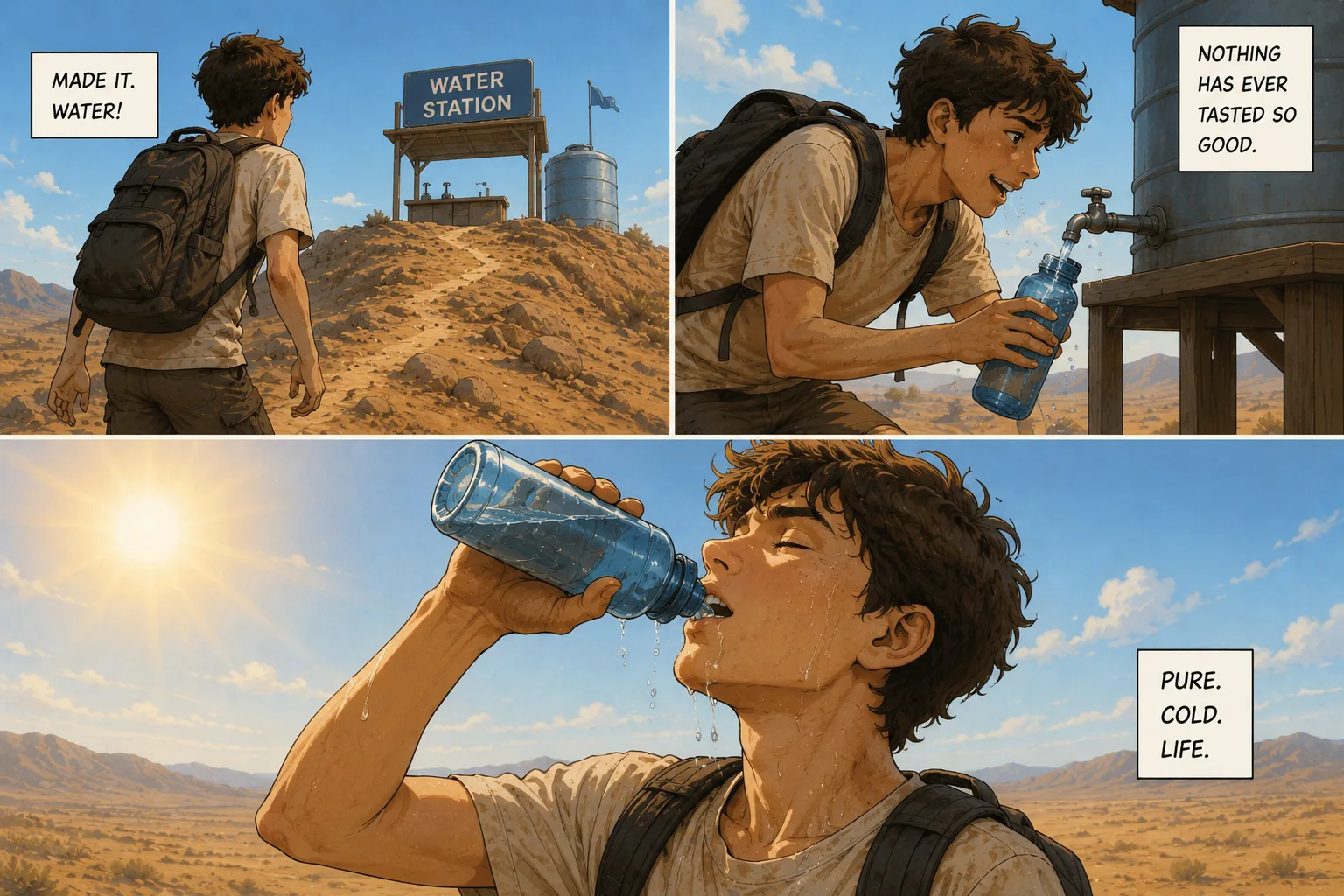
Isaiah does not say you will get the water. He says you will draw it with joy, and the joy is the part teenagers are not expecting. Panel two is not relief. It is delight — eyes closed, face tipped back, water running down his chin. Nothing has ever tasted so good.
That is the claim the gospel actually makes, and it is worth being plain about it in a seminary classroom: the promise is not merely that obedience is correct. It is that He is good, and that you can find that out.
If any man thirst, let him come unto me, and drink. John 7:37
The Savior told a woman at a well that the water He gives becomes a well of water springing up into everlasting life (John 4:14). Lehi tasted the fruit and it filled my soul with exceedingly great joy (1 Nephi 8:12). Alma called it tasting the exceeding joy of which I did taste (Alma 36:24). The scriptures keep reaching for the language of eating and drinking, because those are the things you cannot understand by description. Somebody can tell you what cold water is like. You still have to drink it.
Three — the telling
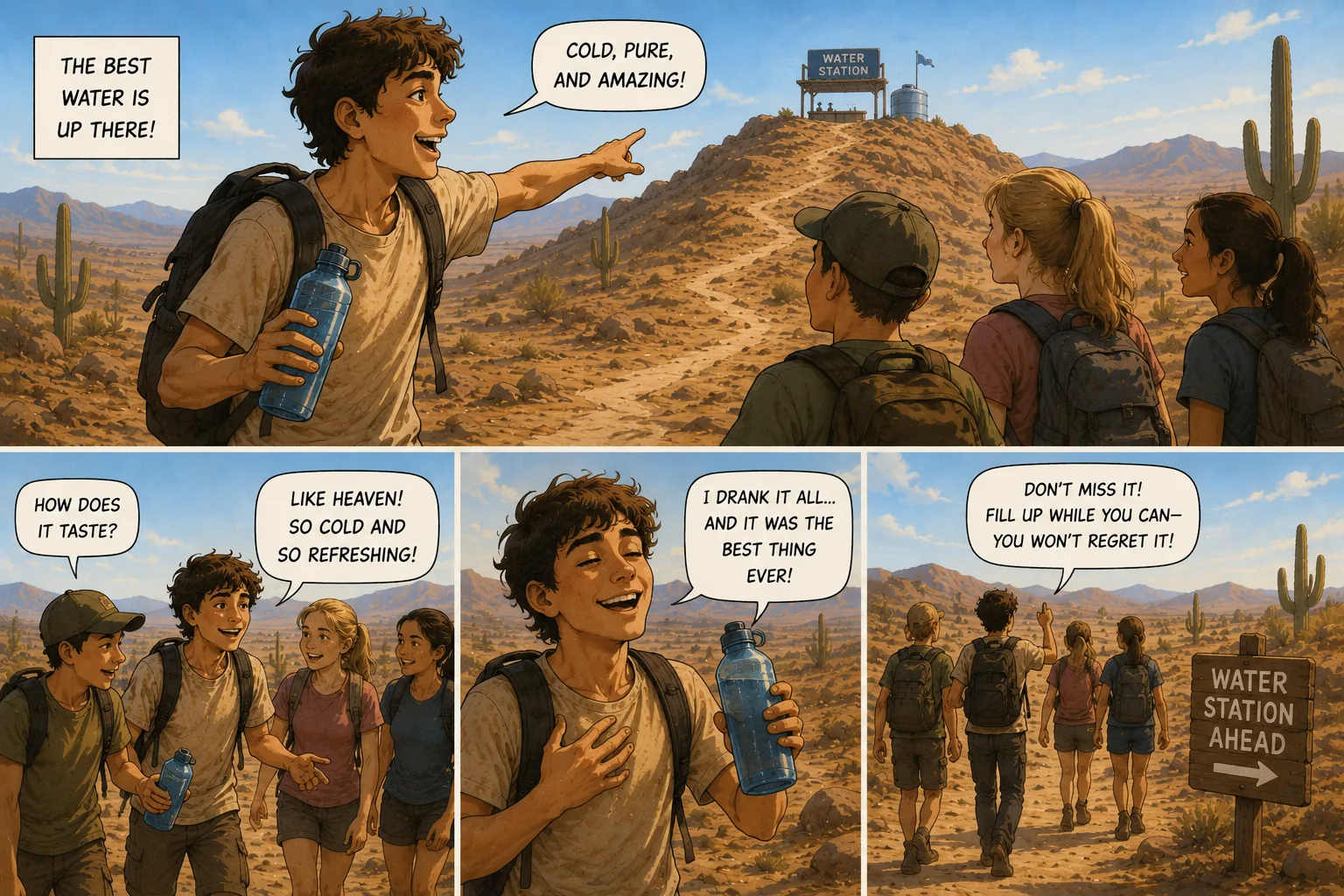
Here is the hinge of the whole year, and it is the second half of the verse: declare his doings among the people.
Notice what he does not do. He does not tell them they are bad hikers. He does not warn them about dehydration. He does not hand them a pamphlet about hydration policy. He tells them how the water tasted — like heaven, so cold and so refreshing — and he points at the hill.
That is praise. We spent weeks on praise in the Psalms this autumn, and this is what it turned out to be for: praise is not a churchy word for being nice about God. Praise is telling the truth out loud about something good that actually happened to you. Psalm 51:15 — O Lord, open thou my lips; and my mouth shall shew forth thy praise. Psalm 86:12 — I will praise thee, O Lord my God, with all my heart. Psalm 150, which counts the ways.
And it is also, without changing a word, what missionary work is. Lehi's first instinct after tasting the fruit was that he began to be desirous that my family should partake of it also (1 Nephi 8:12). Alma's was to labor that I might bring them to taste of the exceeding joy of which I did taste (Alma 36:24). Isaiah saw an ensign raised on a hill that the nations would gather to (Isaiah 11:12) — and Isaiah 12 is the song they sing once they have arrived.
One hill. One tap. A boy who found it, and would not shut up about it.
Why these three, in this order
| Panel | What it is | The verse |
|---|---|---|
| One | Faith and works — believe it is there, and climb | Isaiah 12:3; James 2:17; Alma 32:27 |
| Two | Drawing the water with joy — He is good, and you can find out | Isaiah 12:3; John 4:14; John 7:37 |
| Three | Praise — declare it, and point at the hill | Isaiah 12:4; 1 Nephi 8:12; Alma 36:24 |
The order is not decoration. You cannot skip to panel three. A student who has been told to share the gospel but has never climbed anything and never tasted anything is being asked to recommend water he has not drunk — and everyone can tell. That is exactly why invitations feel awkward, and it is why this class spends most of its time on panels one and two.
What the table does not have a row for is the reason somebody stops walking. There are four, and they get their own section at the bottom of this page.
The takeaway
Climb the hill. Drink the water. Then go tell somebody how good it was.
Everything else on this site — the four cards, the circle of chairs, the journal at the end — is machinery for those three sentences.
How it gets used in class
The panels are a shorthand, not a lesson of their own. Once a class has seen them, a whole idea can be recalled in four words in the middle of something else:
- "That's panel one." — when a student says they prayed once and nothing happened. The experiment is not over; he is halfway up the hill.
- "You're describing the water." — when somebody in the discussion says something true about how the gospel has actually felt to them. Name it as praise while it is still in the air.
- "Who are you pointing at the hill for?" — the invitation question, asked without any of the guilt that usually comes with it.
It also gives the year one recurring picture, which matters more than it sounds. A fifteen-year-old will not remember thirty separate lessons. They might remember a boy on a hill with a water bottle, and every lesson we can hang on him gets to ride along.
Issues — what keeps you from the water
The three panels tell you where the water is. They do not tell you why somebody with a dry mouth, in sight of the tap, sits down. Four things do that, and not one of them is the heat or the hill.
One — pride: “I’m fine.”
The first is deciding you do not need the water.
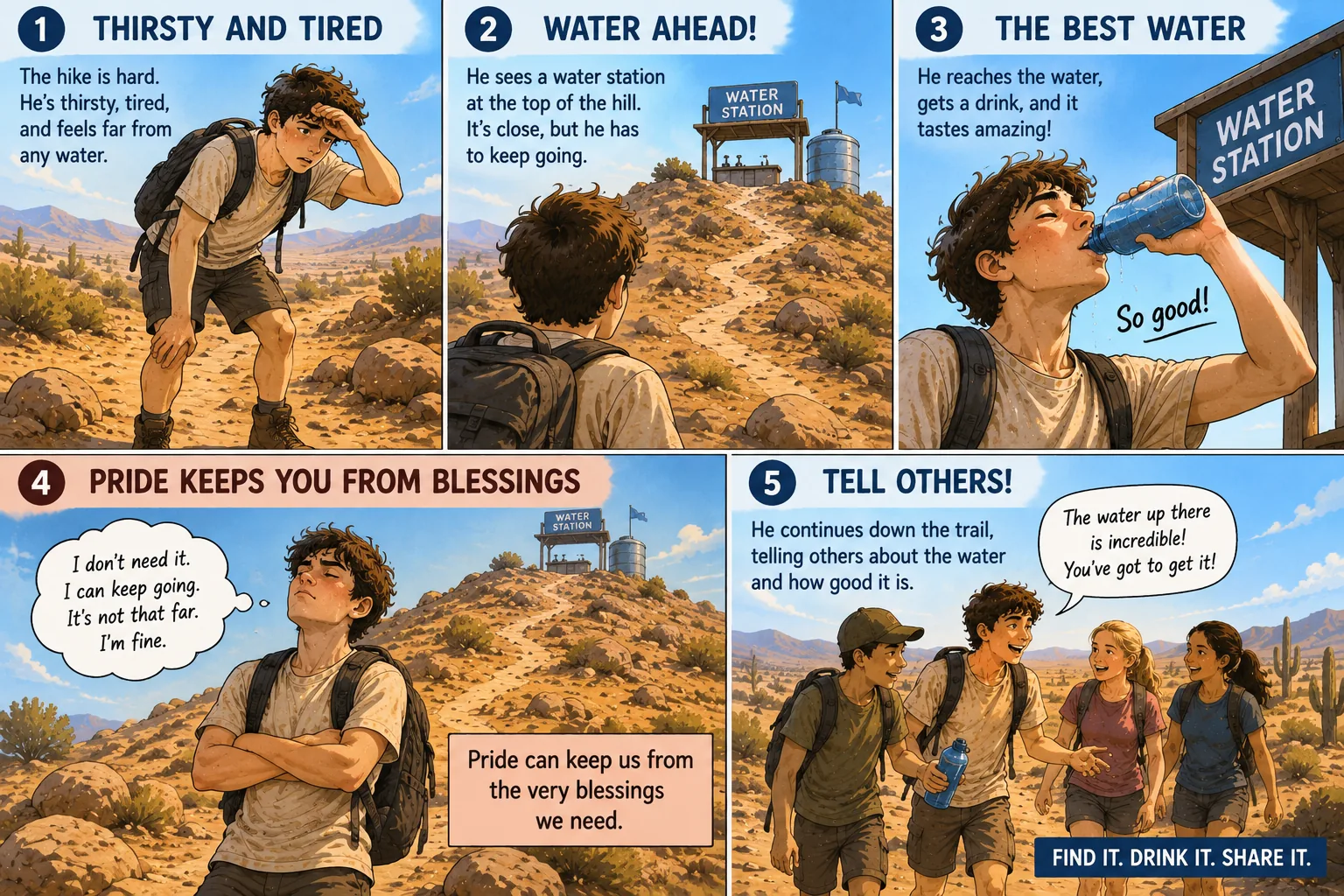
Panel four is the same boy, on the same trail, with the same thirst. Nothing has changed except what he tells himself: I don’t need it. I can keep going. It’s not that far. I’m fine. Arms folded, back to the hill. Every word of it is a lie he would not tell anybody else out loud.
That is pride, and it is worth being exact about what pride is here. It is not thinking too well of yourself. It is the refusal to be someone who needs something — and the water is only ever given to people who admit they are thirsty.
The proud man’s heart is lifted up… but the just shall live by his faith. Habakkuk 2:4
Isaiah says the same thing three chapters earlier, in the verses the class read this month: the lofty looks of man shall be humbled, and the haughtiness of men shall be bowed down (Isaiah 2:11). And the Savior put the whole parable in one line without any desert in it: they that be whole need not a physician, but they that are sick (Matthew 9:12). The boy in panel four is not disqualified. He is just not asking.
For fifteen-year-olds this almost never looks like arrogance. It looks like I’m fine. It looks like not raising a hand, not telling anybody it has been a hard month, not praying about the thing that is actually wrong, not going to the person who could help. Panel four is the most relatable panel on the page, which is exactly why it goes last — it is the one to come back to all year.
And notice where it sits: between the thirst and the drink. Pride does not attack you at the bottom of the hill and it does not attack you at the tap. It gets you partway up, tired, when turning aside is easiest to justify.
Two — judgment: “he doesn’t deserve it.”
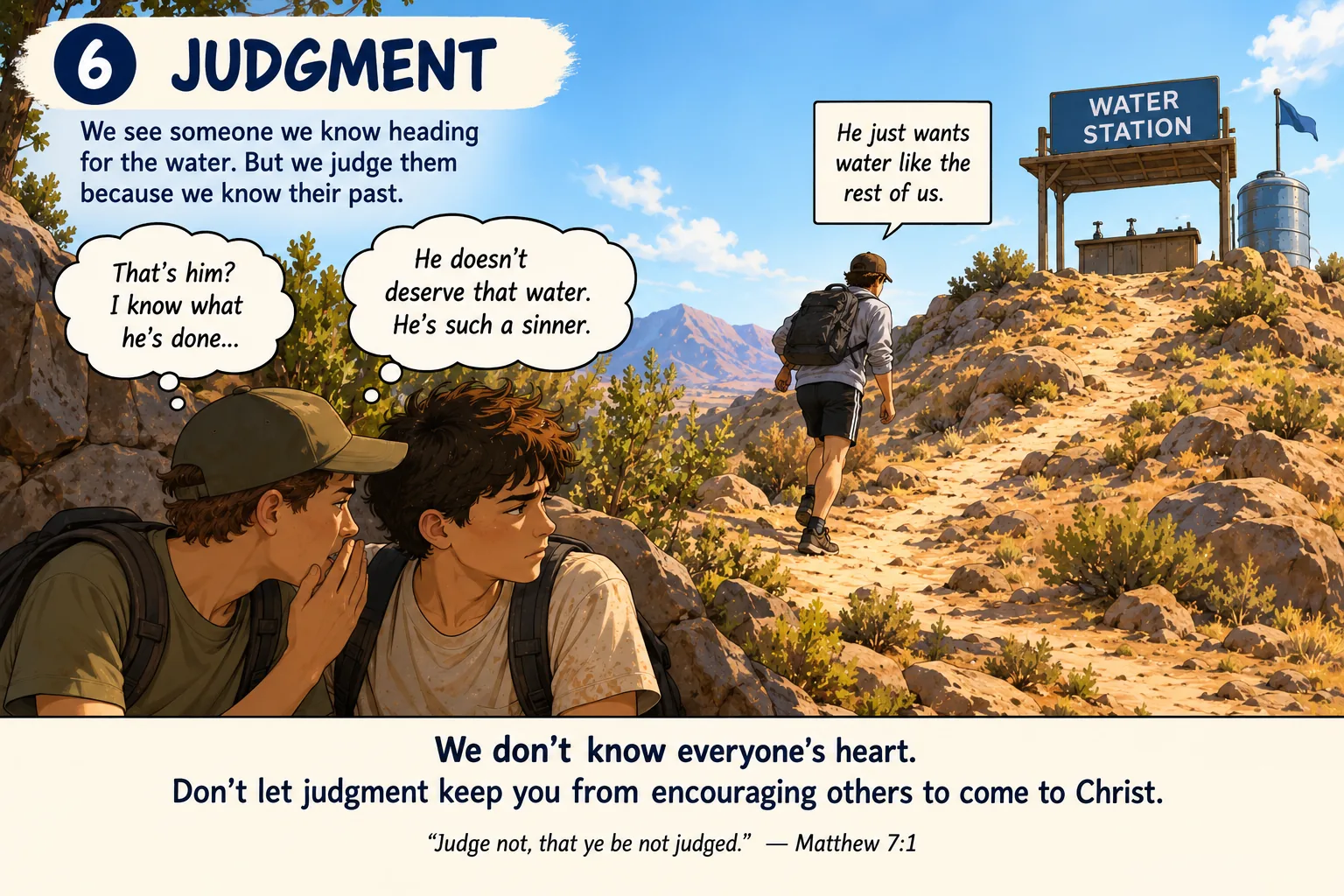
The second is deciding somebody else does not deserve it — and the question worth sitting with is how on earth that stops you. It is not obvious. The water is still there. Nobody took your bottle. So why does judging another hiker leave you standing in the sand?
Three ways, and they get worse as they go.
It kills panel three. You cannot point somebody at a hill you have just decided they are not good enough to climb. The invitation dies in your mouth before you say it, and you get to tell yourself you were being discerning rather than afraid. Everything this page says about declaring His doings among the people stops here, at the first sentence you do not say.
It costs you the climb itself. Look at the picture again. The two who are judging are crouched behind a rock. The one they say does not deserve the water is halfway up the hill. Auditing who deserves the tap is a full-time job, and it is done sitting down. This is what Jesus meant by the mote and the beam — not that you are worse than them, but that the inspection is eating the eye you were going to walk with (Matthew 7:3–5).
And it changes what you think the water is. This is the one that actually does the damage. The moment you say he doesn’t deserve that water, you have said water is something people deserve — that the tap pays out for good behaviour. Isaiah, three chapters before the two verses this whole year hangs on, says the exact opposite:
Ho, every one that thirsteth, come ye to the waters… come ye, buy, and eat; yea, come, buy wine and milk without money and without price. Isaiah 55:1
There is no price. Judgment invents one. And here is the trap: you will be charged it too. For with what judgment ye judge, ye shall be judged: and with what measure ye mete, it shall be measured to you again (Matthew 7:2). Set the bar at deserving and you have to clear it yourself — and you know your own record better than you know his. The same sentence that disqualifies him quietly disqualifies you. That is not a separate problem; it is the next panel.
The Savior told this exact parable with a temple instead of a hill: two men went up to pray, and the one who was sure of the other man’s record went down to his house un-justified, while the one who would not lift his eyes went home forgiven (Luke 18:10–14). Same trail. Same water. The man at the back got there first.
For the Lord seeth not as man seeth; for man looketh on the outward appearance, but the Lord looketh on the heart. 1 Samuel 16:7
“I know what he’s done” is almost always true and almost never the point. You know what he did. You do not know what it cost him, what he has already repented of, or how far he walked this morning. Nobody in that picture knows why the man on the trail is thirsty. They only know he is, which is the one qualification the water has ever required.
Three — “not for me.”
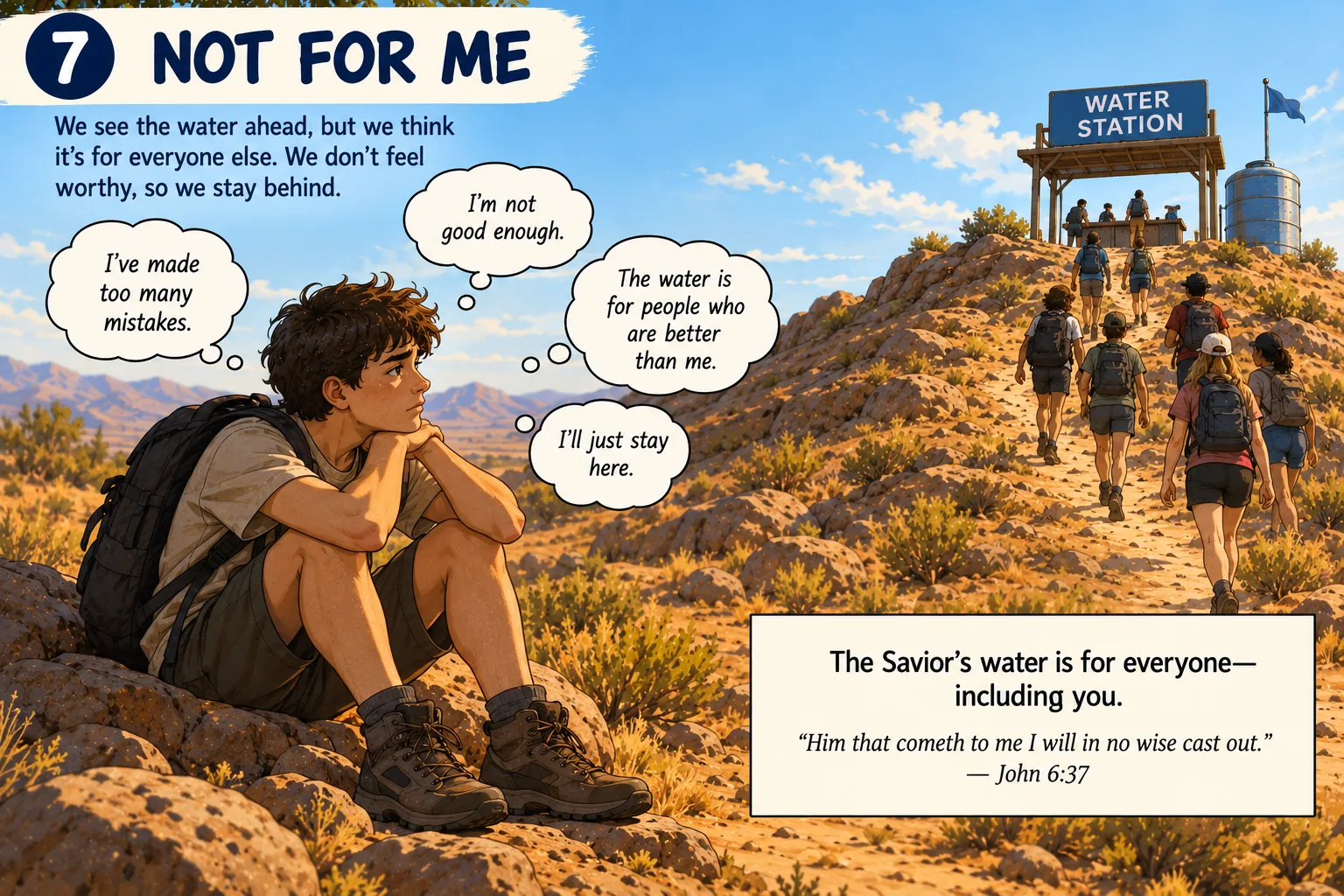
This is the quietest one, and in a seminary class it is the most common by a long way. He is not proud and he is not judging anybody. He is sure the water is real and sure it is good and sure it is for the people going past him. I’ve made too many mistakes. The water is for people who are better than me. I’ll just stay here.
Look at what the picture is careful to show. He has boots on. He has a pack. He is not at the trailhead — he is partway up, close enough to read the sign. He did the hard part. Then he sat down, and everyone else kept walking. Nothing physical is stopping him. A sentence is.
And notice that it is the same sentence as panel six, said from the other seat. The boys behind the rock said he doesn’t deserve that water. This boy says I don’t deserve that water. Both of them believe the tap has a price. One thinks somebody else cannot afford it; the other has checked his own pockets and agreed. Judgment and shame are one error wearing two faces, which is why a class that is hard on other people is usually hard on itself.
All that the Father giveth me shall come to me; and him that cometh to me I will in no wise cast out. John 6:37
In no wise. Not unless. There is no clause. And the Book of Mormon says it without leaving any room to wriggle: he inviteth them all to come unto him and partake of his goodness; and he denieth none that come unto him… and all are alike unto God (2 Nephi 26:33).
The verse to hand a student sitting on that rock is one this class read on the fifteenth of September, in Isaiah 1:
Come now, and let us reason together, saith the Lord: though your sins be as scarlet, they shall be as white as snow; though they be red like crimson, they shall be as wool. Isaiah 1:18
Isaiah says that to a nation he has just spent seventeen verses describing as filthy. It is not addressed to people who were doing well. Neither is the water.
So those three are one shape seen three ways, and the Savior named all of them in a single line: they that be whole need not a physician, but they that are sick… I am not come to call the righteous, but sinners to repentance (Matthew 9:12–13).
Four — another path: “this is way easier.”
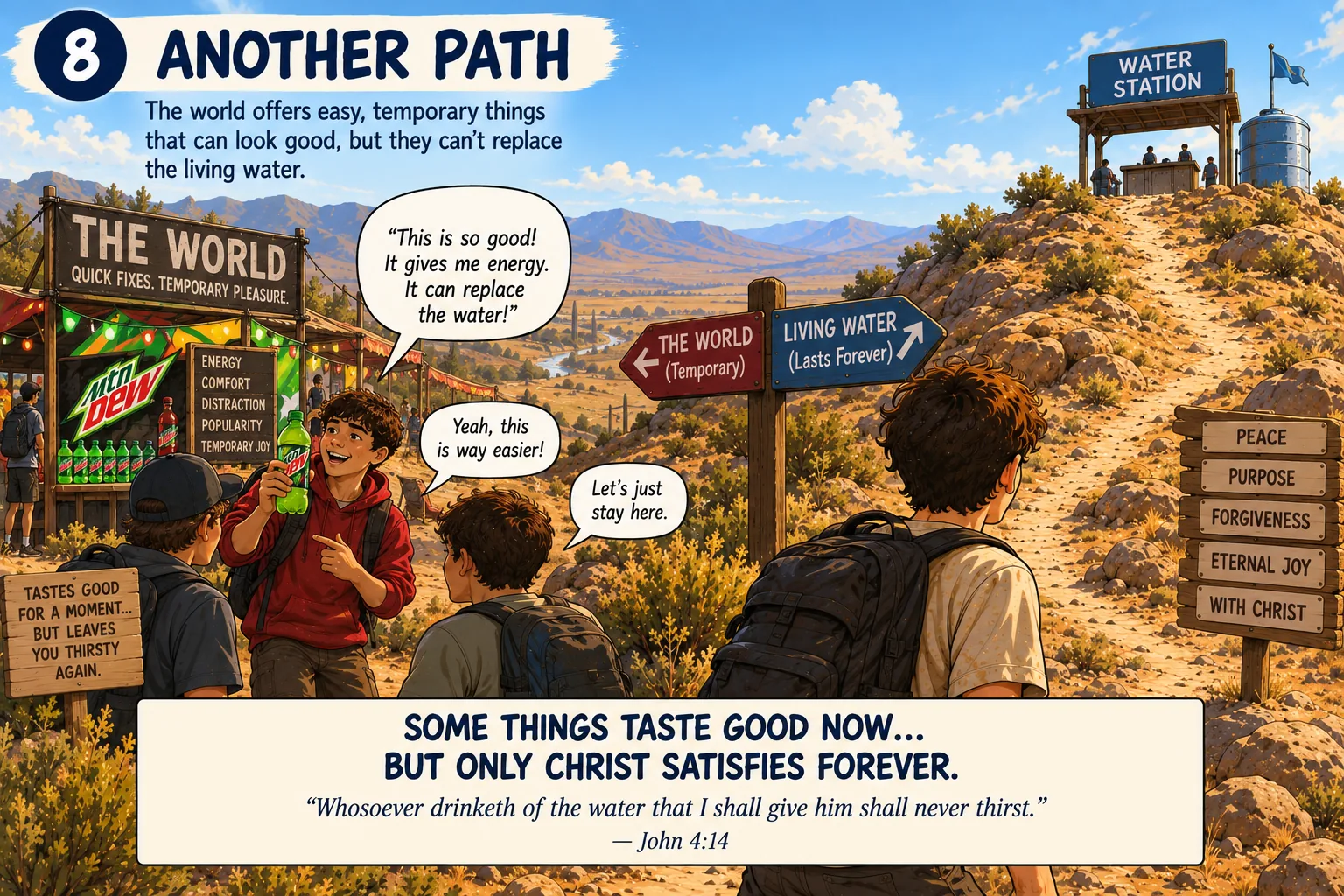
This one is different in kind from the other three, and it is worth saying so out loud. Pride, judgment and shame are all refusals — three ways of not going. This one is a substitute. It puts something in your hand. That is why it is the hardest of the four to argue with, and why arguing with it badly does so much damage.
Look where the stall is
Before anything else on this panel, make a class notice where the stall is pitched. It is not scenery. It is the whole argument.
It is at the bottom. On flat ground, at the easy end of the trail, with lights strung over it. The soda station is not on the hill. The water station is.
Panel one said the water is uphill, and that reaching it takes two things: believing it is up there, and climbing. The stall asks for neither. You do not have to believe in a cold drink — it is already in your hand. You do not have to climb for it — it came to you. No faith, because you can see it. No works, because there is no hill.
That is what this is way easier means in that speech bubble. It is not a claim that the drink is better. It is a claim that there is nothing to walk up. And look at the signpost standing between the two: the arrow for LIVING WATER points up, and the arrow for THE WORLD points back the way they came. The world’s direction is always a direction you have already walked.
The thing to say out loud
Everything the world sells is at the bottom of the hill. That is its entire sales pitch — and it is also the reason none of it holds.
Free is not the same as easy, and the difference matters. This page has argued hard that the water has no price — without money and without price (Isaiah 55:1), in no wise cast out (John 6:37). All of that stands. But read the first three words of Isaiah’s invitation again: come ye to the waters. Come is a verb of travel. Nobody is charged for the water. Everybody still walks to it. The climb was never the payment; it is simply where the tap is.
Which is why the stall cannot sell you panel two. It can sell you a drink. It cannot sell you the arrival. Nothing has ever tasted so good was never a fact about water chemistry — it was a fact about a boy who had walked a long way in the sun and finally got there. Take the hill out and you have a cold drink: a perfectly nice thing, finished in ten minutes, and you are standing exactly where you started.
So the location is also the tell. Repentance stands in front of forgiveness. An experiment stands in front of a testimony (Alma 32:27). A covenant stands in front of a temple. When something offers you peace or worth or joy and asks you to walk zero steps uphill for it, that is not a better deal on the same product. It is the identifying mark of a different tap.
Because here is the thing a seminary teacher must not pretend: the drink is actually cold. It really does taste good. If we tell fifteen-year-olds that everything the world offers is disgusting, they will find out within the week that we were lying, and then they will reasonably wonder what else we exaggerated. The sign in the picture does not say the drink is poison. It says something far more useful: tastes good for a moment… but leaves you thirsty again.
That is not our line. It is the Savior’s, and He said it at a well to a woman who had come for ordinary water:
Whosoever drinketh of this water shall thirst again: but whosoever drinketh of the water that I shall give him shall never thirst. John 4:13–14
Notice what He does not say. He does not say the well is bad. He does not tell her to stop drinking water. He says you will be back tomorrow — and she was, which is how she knew He was right. The argument against the stall is not that it lies about the taste. It is that it lies about the duration.
Jeremiah put it in one image, and it is the image this whole panel is drawn from:
For my people have committed two evils; they have forsaken me the fountain of living waters, and hewed them out cisterns, broken cisterns, that can hold no water. Jeremiah 2:13
Two evils, not one. Leaving the fountain is the first. Digging your own tank is the second — and here is the sting in it: that is enormous work. Nobody in that picture is lazy. They have built a marketplace, hung the lights and are running it in the sun, and the hill would have taken twenty minutes. The easy path is not the one with less effort in it. It is the one with no climb in it, which is not the same thing at all. Isaiah asks the obvious question one verse after the without money and without price quoted further up: wherefore do ye spend money for that which is not bread? and your labour for that which satisfieth not? (Isaiah 55:2).
Read the two boards
The picture does something clever, and it is worth making a class find it. Both sides are advertising. Put the lists side by side:
| The stall offers | The trail offers |
|---|---|
| Energy | Peace |
| Comfort | Purpose |
| Distraction | Eternal joy |
| Popularity | With Christ |
| Temporary joy | Forgiveness |
Four of them have a rough match: energy against peace, distraction against purpose, temporary joy against eternal joy, a crowd against a Person. Then look at the last row. The world’s board has no forgiveness on it. It does not sell that. It cannot. Everything in the stall is an anaesthetic, and not one item on the shelf can do anything at all about what you did — which is exactly the thing panel seven was sitting on a rock about.
And read the dialogue, because it is not what adults expect. Nobody at that stall says let us do something wicked. They say this is way easier and let’s just stay here. That is the real version. It is not a dramatic turn away from the hill. It is a decision to not start walking, made by people who can see the water station from where they are standing.
| Issue | What it says | What it gets wrong | The answer |
|---|---|---|---|
| Pride | I’m fine. | I am not thirsty | Matthew 9:12 |
| Judgment | He doesn’t deserve it. | The water has a price | Matthew 7:1–2; Isaiah 55:1 |
| Not for me | I don’t deserve it. | The water has a price | John 6:37; Isaiah 1:18 |
| Another path | This is way easier. | A thing off the hill will hold | John 4:13–14; Jeremiah 2:13 |
Pride says I am not sick. Judgment says he is too sick. Shame says I am too sick. The stall says try this instead. All four end the same way — somebody dry, on a trail, in the sun, within sight of a tap that was free the whole time.
The class version, in five questions
Panel four: what is the thing you keep saying you are fine about?
Panel six: who have you already decided about?
Panel seven: what have you decided about yourself?
Panel eight: what are you drinking instead — and did you have to
climb anything to get it?
All four: you can see the station from here. What is the actual reason you
are still standing at the bottom?
These panels were made with AI image generation for this class, the same way the teaching cards are. They illustrate a parable written for these students; they are not scripture, not Church curriculum, and not an official depiction of anything. Other teachers are welcome to use them.