Lessons · Mon Nov 2, 2026 · Scripture
Ezekiel 1–3; 33 — "I Have Made Thee a Watchman"
Ezekiel 1–3; 33–34; 36–37; 47
The principle
The Lord calls prophets to serve as watchmen who warn us of spiritual dangers we cannot see. He warns because He loves us — He has no pleasure in the death of the wicked, only that they turn and live.
What the lesson is for
Let students find in Ezekiel 3 and 33 that a prophet is a watchman who sees what we cannot, find in 33:11 why the Lord bothers to warn at all, and leave having named one current prophetic warning they are going to act on rather than just agree with.
Personal study, first ten minutes
Ezekiel 3:16–17; 33:1–11
Ezekiel is a captive in Babylon, preaching to other captives. Read 3:17 and find the job title the Lord gives him — it is a doctrinal mastery passage, so mark it. Then read 33:2–6 and find who is responsible if the trumpet is blown and nobody moves, and who is responsible if it is never blown. Finish at verse 11 and find what the Lord says He takes no pleasure in.
The deck
Click any card to see it full size.
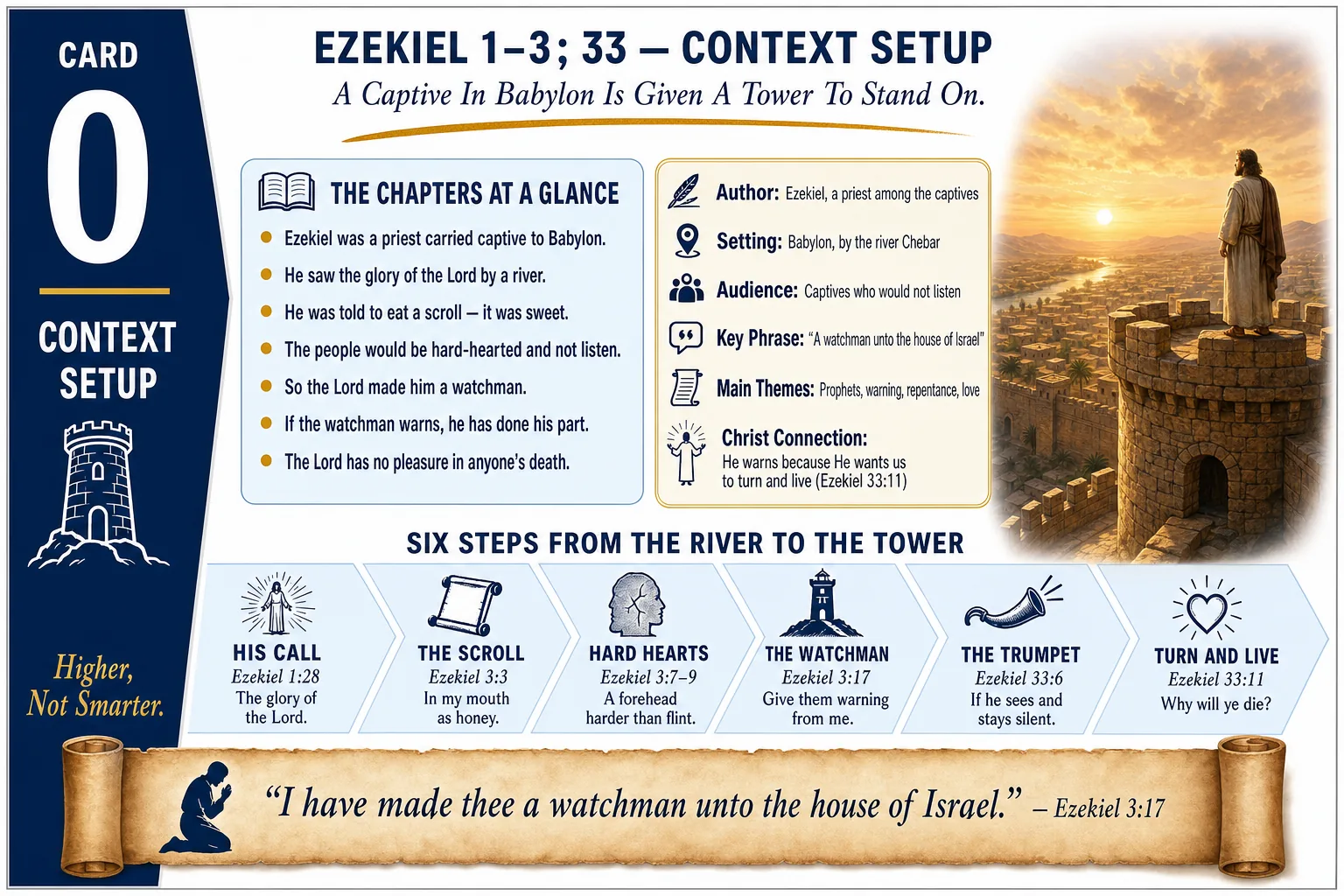
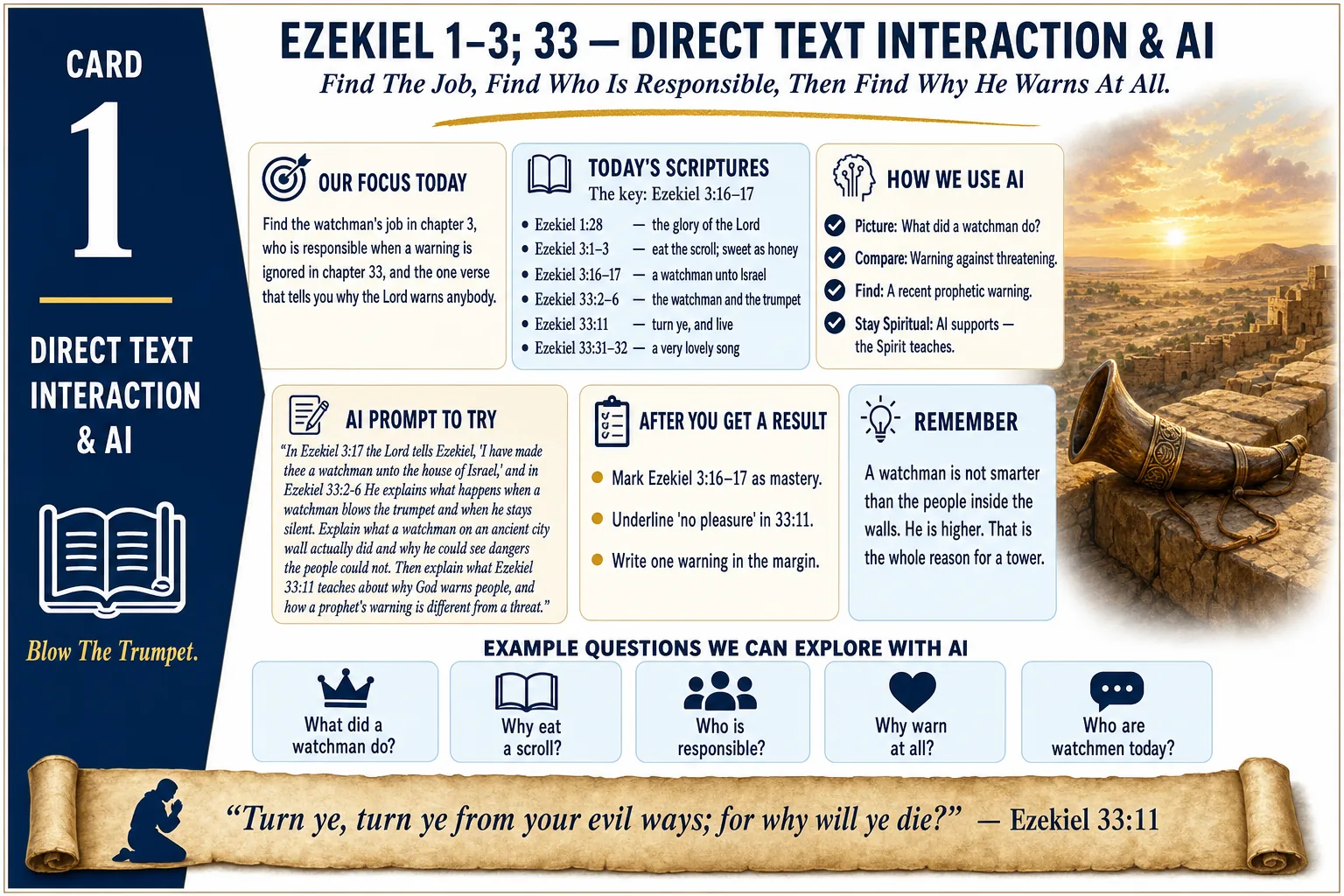
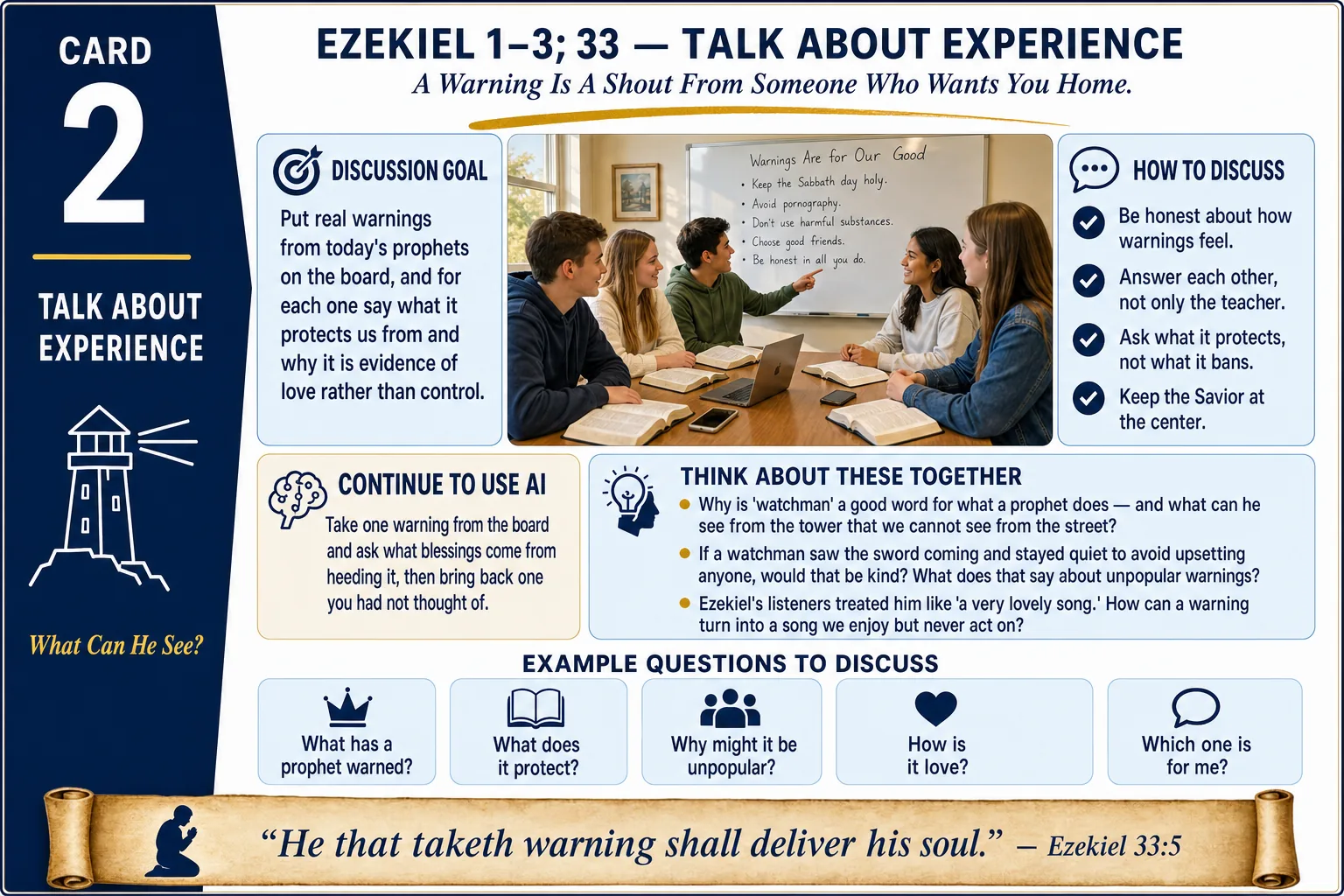
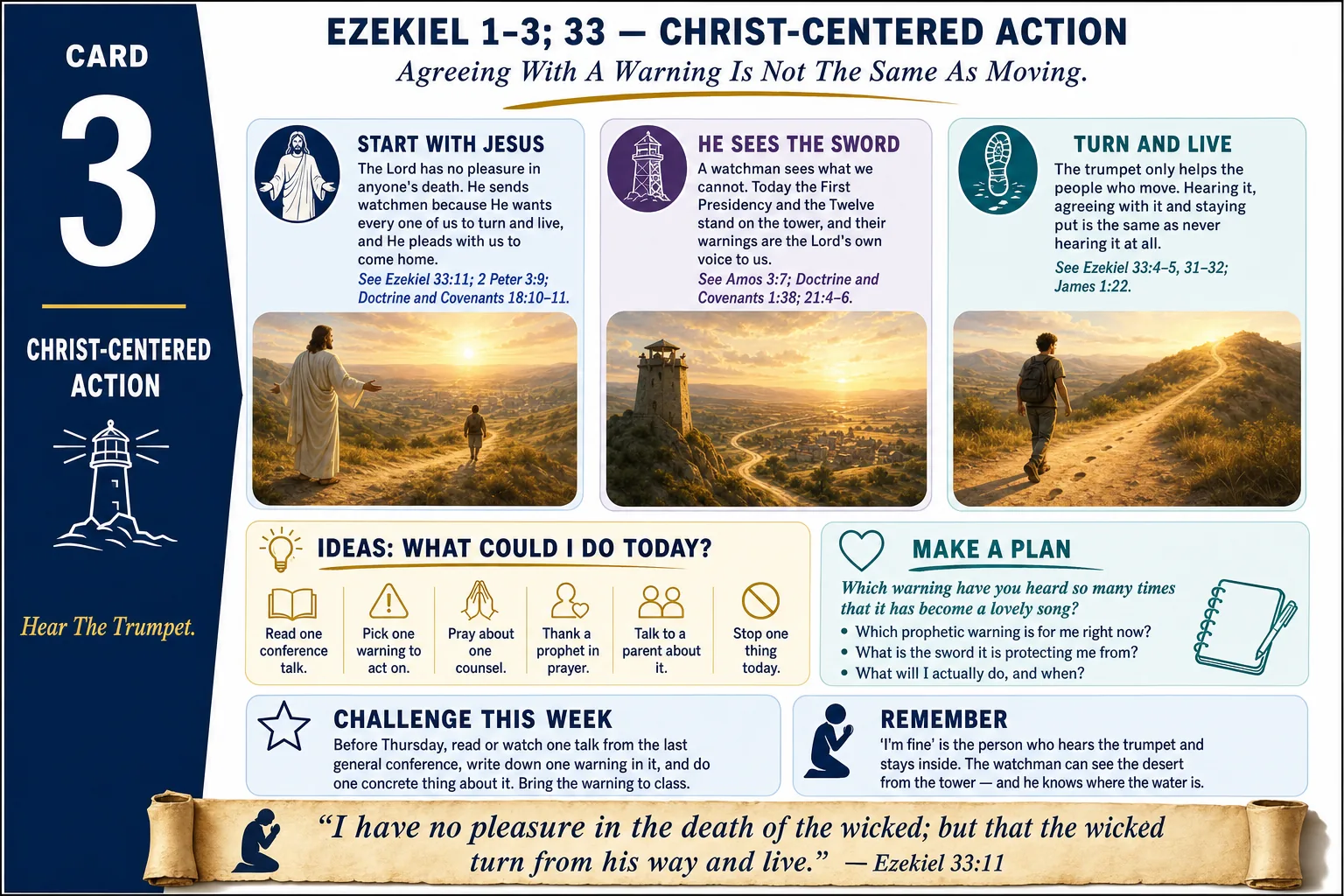
Teacher notes
Supplies, board work and timing. Never printed on the cards.
SUPPLIES: a picture of the President of the Church, the Carcassonne image from the manual (search 'Carcassonne towers' — any photo of the walled city works), and board space. OPEN WITH FEELINGS ABOUT THE PROPHET, HONESTLY. Show the picture, and if you want, play the first verse of 'We Thank Thee, O God, for a Prophet' (Hymns, no. 19). Then the sentence for the study journal: 'When I see the prophet, listen to him speak, or read his words, I feel …' Say out loud before they write that the answers will vary and that is fine — grateful, inspired, guilty, bored, not sure. An honest 'not sure' is a better start than a polite 'grateful,' and the lesson is written for that student. CONTEXT IN ONE BREATH: Ezekiel was carried to Babylon in the same deportation as King Jehoiachin, years before Jerusalem fell. He was a priest who never served in the temple. Chapter 1 is his call — a vision of the glory of the Lord by the river Chebar, with a rainbow round about it (1:28). In 2:8–3:3 he is told to eat a scroll of the Lord's words, and it is sweet as honey in his mouth. Then 3:7–9: the people will not listen to you, so I have made your forehead harder than flint. THE WATCHMAN IS THE LESSON. Read 3:10–11 and 16–17 together. 3:16–17 is a DOCTRINAL MASTERY PASSAGE — have them mark it the way they mark the others, and say the key phrase: 'The prophet is a watchman unto the house of Israel.' Then put up Carcassonne and read Elder Neil L. Andersen: 'A prophet is a watchman on the tower, protecting us from spiritual dangers we may not see' ('The Prophet of God,' Liahona, May 2018, 25). The words to underline are 'may not see.' The watchman is not smarter than the people inside the walls; he is higher. That is the whole reason for a tower. Ask why 'watchman' is a good word for a prophet, and remind them the First Presidency and the Quorum of the Twelve are the watchmen today. THEN 33:2–6, AND NOTICE THE RESPONSIBILITY RUNS BOTH WAYS. If the watchman blows the trumpet and the people do not move, that is on them (33:4–5). If the watchman sees the sword and stays quiet, that is on him (33:6). A prophet who saw something and said nothing to spare our feelings would be failing at the one job he was given. That reframes every unpopular thing a prophet has ever said. 33:11 IS THE HEART AND YOU SHOULD SLOW DOWN FOR IT: 'As I live, saith the Lord God, I have no pleasure in the death of the wicked; but that the wicked turn from his way and live: turn ye, turn ye … for why will ye die, O house of Israel?' Ask what that verse teaches about Heavenly Father and Jesus Christ. Then Elder Christofferson: 'Far from being anxious to condemn, our Heavenly Father and our Savior seek our happiness and plead with us to repent' ('The Voice of Warning,' Liahona, May 2017, 108). A warning is not a threat from somebody who wants you to fail. It is a shout from somebody who can see the sword and wants you home. 33:31–32 IS A SHARP OPTIONAL BEAT IF YOU HAVE A MINUTE: the people came and sat and listened to Ezekiel like he was 'a very lovely song of one that hath a pleasant voice' — and did not do any of it. Ask whether general conference can become a lovely song. WARNINGS FROM THE WATCHMEN, IN PAIRS: half the room takes a recent general conference talk on their phones, half takes the doctrinal mastery passages the manual lists — Isaiah 5:20; 1 Corinthians 6:19–20; 2 Nephi 2:27; 2 Nephi 32:8–9; Alma 41:10; Doctrine and Covenants 64:9–11. Each pair finds one warning, what it protects us from, and why it is evidence of love. Each pair writes their warning on the board in a few words. Pick two or three to discuss, and ask the pair who wrote it for the 'evidence of love' half, because that half is the lesson. KEEP IT FROM BECOMING A LIST OF DON'TS. The question is not 'what are we not allowed to do,' it is 'what is the sword they can see from up there that I cannot see from down here.' THE AI PROMPT on card 1 is for the pairs that finish early. THEME LINK, ONE SENTENCE: a watchman on the wall is the one who can see the desert and knows where the water is; panel four, 'I'm fine,' is exactly the person who hears the trumpet and stays put. THE WEEK: today the watchman, tomorrow the word comes in two books joined in one hand, Wednesday water comes out of the house of the Lord, Thursday you find out what you promise when you go in. TIMING: feelings about the prophet and the journal line four minutes, Ezekiel's call and the scroll three, the watchman and Carcassonne six, 33:2–11 and Christofferson six, warnings in pairs and the board nine, close two, journals at 7:05. If you are behind, cut 33:31–32 and the scroll, never 33:11.
Journal prompt
The last five minutes. Card 3 hands into this.
Finish the line you started at the beginning: 'When I see the prophet, listen to him speak, or read his words, I feel …' and notice whether it changed in thirty minutes. Then write one warning from a living prophet that you think is meant for you, what it might be protecting you from that you cannot see from where you stand, and the one thing you will do about it this week. Finish with: 'I want to follow the Lord's prophet because …'