Lessons · Wed Oct 28, 2026 · Scripture
Lamentations 1; 3 — "His Compassions Fail Not"
Jeremiah 31–33; 36–38; Lamentations 1; 3
The principle
The Lord has compassion for us even when we sin. Compassion in the scriptures means literally to suffer with — He has, which is why His mercies are not a supply we draw down but something new every morning, including this one.
What the lesson is for
Get the things people believe about themselves after they sin onto the board unedited, let Lamentations 3 answer them line by line, and have every student leave knowing that compassion means He has already suffered with them for the thing they are carrying.
Personal study, first ten minutes
Lamentations 3:22–26, 31–33
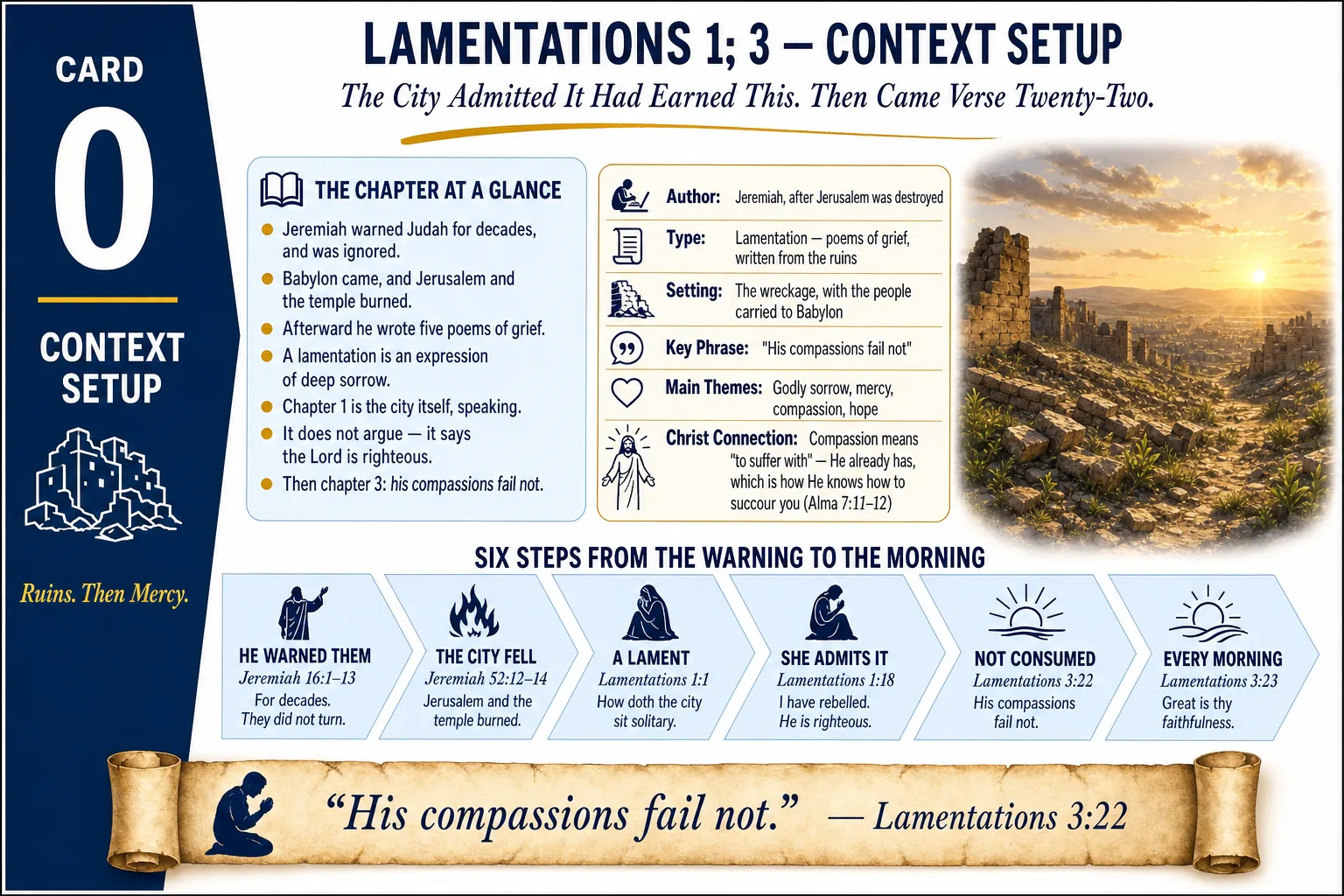
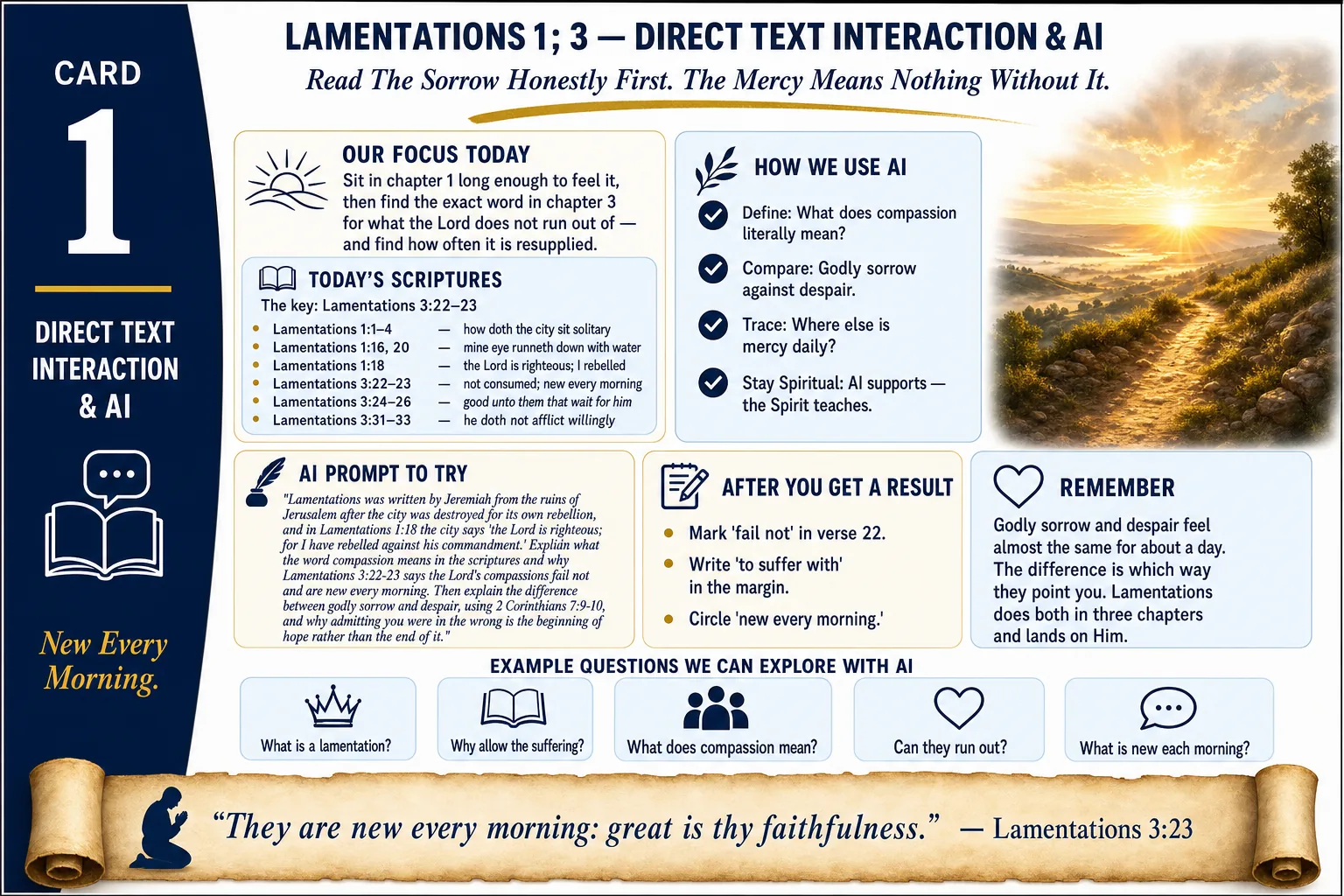
This is written from the ruins of a city that had been warned for decades and did not listen. Read verse 22 and find the two things the Lord has that keep the people from being consumed — one of them is the word the whole lesson turns on. Then read verse 23 and notice how often they are resupplied. Finish at 31 to 33 and find what the Lord does not do willingly.
The deck
Click any card to see it full size.

Teacher notes
Supplies, board work and timing. Never printed on the cards.
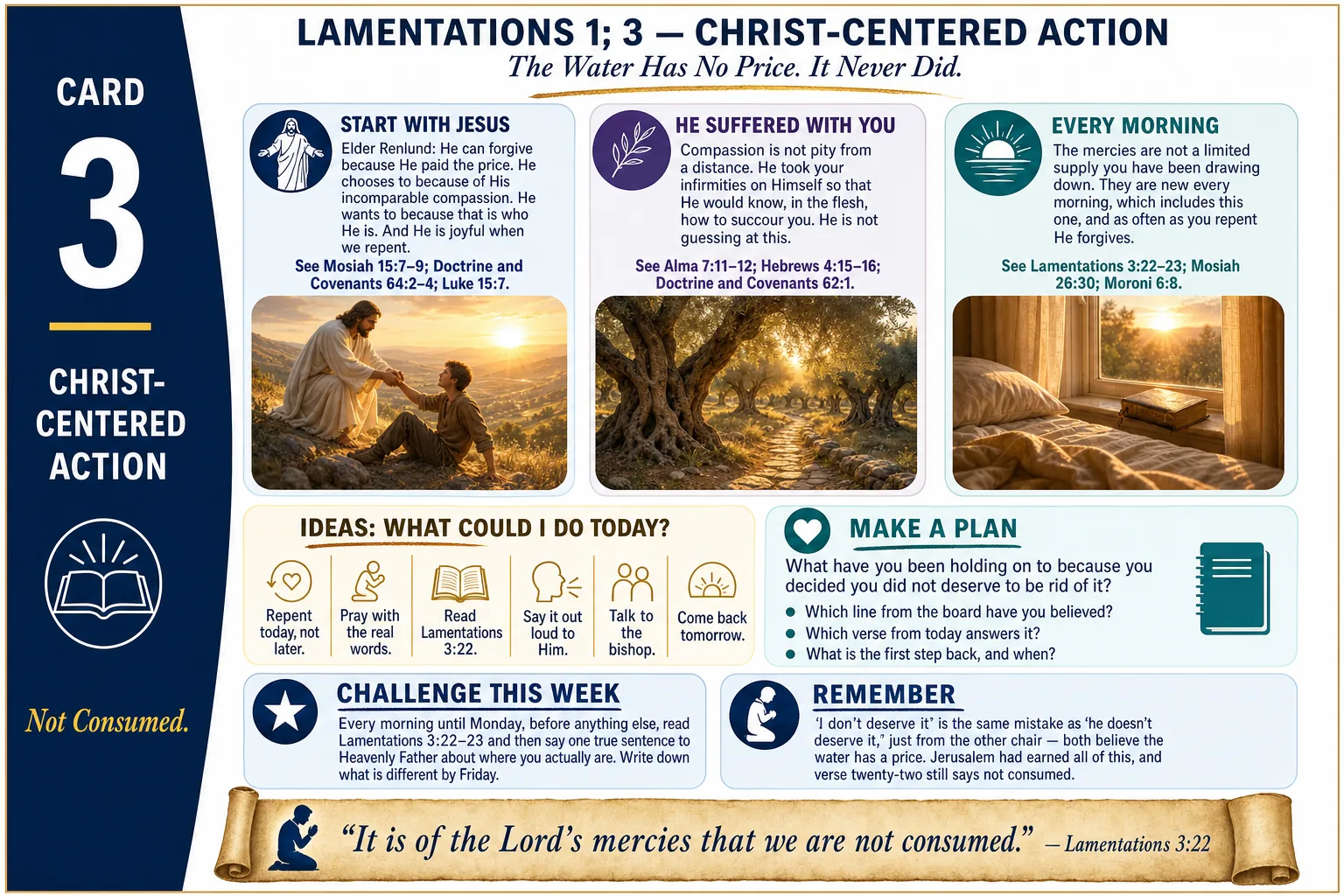
SUPPLIES: board space you are willing to leave covered for the whole lesson, and the picture of Jeremiah sorrowing. The video is 'Painted into a Corner' on ChurchofJesusChrist.org — 0:00 to 1:47 at the start and 1:48 to 3:41 at the end, and if you only have time for one half, use the second. THE BOARD IS THE LESSON. Open with the scenario the manual gives — a young man who has made good choices, gives in at a party, drinks, and wakes up feeling alone and guilty, then starts making other poor choices and losing hope for his future — or show the first half of the video instead. Then two questions, and write down every answer: when people sin, how might they see or feel about themselves, and how might they see or feel about Heavenly Father and Jesus Christ? Do not edit the list, do not correct anything yet, and push until it is honest. I'm disgusting. He's done with me. I can't pray now. Everybody would be ashamed of me. I may as well keep going. That last one is the whole reason the lesson exists. THEN THE QUIET QUESTION, AND GIVE IT REAL SILENCE: have you ever thought any of the statements on the board? Which of these do you know are false, and which are you unsure about? Nobody answers out loud. The honest answer for most of them will be that they know it is false in general and are not sure it is false about them, and that gap is what Lamentations 3 is for. ROMANS 3:23 GOES UP EARLY — we all sin and come short of the glory of God — because otherwise the first half of this lesson can feel aimed at somebody in particular. It is aimed at everybody. SORROW BEFORE MERCY, AND DO NOT RUSH IT. Show the picture of Jeremiah and let them say what they see. Explain that lamentation means an expression of deep sorrow. Give the background: for decades Jeremiah told Israel that Jerusalem would be destroyed and the people taken captive if they would not turn back (see Jeremiah 16:1–13); under Zedekiah the Babylonians did exactly that, and burned the house of the Lord (see Jeremiah 52:12–14); afterward Jeremiah wrote Lamentations. Then pairs, one or two passages each — 1:1–4, 1:16–18, 1:20–22 — looking for the words and phrases for how the people felt. Tell them the city itself is speaking; that is why it reads so strangely. 1:18 IS THE VERSE TO STOP ON: 'The Lord is righteous; for I have rebelled against his commandment.' Jerusalem does not argue. It had earned this and says so. Ask why admitting that is the beginning of hope rather than the end of it, and if they are stuck, hand them 2 Corinthians 7:9–10, Alma 42:18, 29 and Doctrine and Covenants 95:1. GODLY SORROW AND DESPAIR FEEL NEARLY IDENTICAL FOR ABOUT A DAY, and this is the distinction worth teaching plainly. Both hurt. One points you toward Him and one points you away. Lamentations does both inside three chapters and lands on Him, which is exactly why the book is in the canon. THEN 3:22–26 AND 31–33, IN PAIRS, ONE HALF EACH, with the board still up: which words or phrases would you hand to somebody who feels like the statements on the board? It is of the Lord's mercies that we are not consumed, because his compassions fail not. They are new every morning: great is thy faithfulness. He will not cast off for ever. He doth not afflict willingly. Take the answers against the board, line by line, out loud. DEFINE COMPASSION, BECAUSE IT IS THE HINGE AND THEY WILL HEAR IT AS PITY. 'In the scriptures, compassion means literally to suffer with. It also means to show sympathy, pity, and mercy for another' (Guide to the Scriptures, 'Compassion,' Gospel Library). Suffer with. Then Alma 7:11–12 — He took upon Him their infirmities that He might know how to succour His people — and the sentence that does the work: He is not sympathising from a distance about something He has not been through. 'I don't deserve His help' assumes the help is still being decided. It was decided in Gethsemane. THE STUDY OPTIONS ARE GOOD AND SHORT: Matthew 18:23–35 or John 8:1–11 for a story; Mosiah 15:7–9, Doctrine and Covenants 64:2–4 or 101:9 for the doctrine. Or let a student bring the story they thought of in their own preparation — the manual asks them for one, so ask who has one before you hand out options. Then they teach each other. ELDER RENLUND IS THE CLOSE AND IT IS FOUR SENTENCES WORTH SAYING SLOWLY: Jesus Christ can forgive because He paid the price for our sins; He chooses to forgive because of His incomparable compassion, mercy, and love; He wants to forgive because this is one of His divine attributes; and like the Good Shepherd He is, He is joyful when we choose to repent ('Repentance: A Joyful Choice,' Liahona, Nov. 2016, 123). Can, chooses, wants. Three different objections answered in order. FINISH WITH THE YOUNG MAN FROM THE OPENING — what would you say to him now? — and then the second half of the video, looking for evidence of the Savior's compassion for him. The symmetry is the point: they answered for him at the start out of the board, and they answer for him at the end out of Lamentations 3. BEAR YOUR TESTIMONY, and keep it about Him rather than about repentance as a process. THEME LINK, PANEL SEVEN, AND SAY IT BY NAME: 'I don't deserve it.' That is the same error as panel six — 'he doesn't deserve it' — from the other chair, and both of them believe the water has a price. Isaiah 55:1 and John 6:37 say it has none. Jerusalem had earned every bit of what happened to it and verse 22 still says not consumed. THE WEEK: Monday He wrote His law in your heart, Tuesday you watched a man burn the words that do the writing, today you find out what He does when you break it anyway, tomorrow you go to the house where He promised to dwell with you. THE MORNINGS ARE NOT A COINCIDENCE either — they are in this room at 6:20, and 3:23 says the mercies are new every morning. Point at the window. TIMING: scenario or video and the board eight minutes, the quiet question two, Jeremiah's sorrow and chapter 1 in pairs seven, 3:22–33 in pairs and against the board eight, compassion defined and Alma 7 three, Renlund and the young man three, journals at 7:05. If you are behind, cut the chapter 1 pairs to one passage — but the sorrow cannot be cut entirely, because the mercy does not mean anything without it.
Journal prompt
The last five minutes. Card 3 hands into this.
Write down the one line from the board that you have actually believed about yourself — nobody will read this. Beside it, copy out the words from Lamentations 3 that answer it, in the Lord's own wording. Then write what 'compassion means to suffer with' changes about the thing you have been carrying, and finish with the first step back and the day you will take it. If the honest answer this morning is that you are not sure the verse applies to you, write that down too, and read verse twenty-three again tomorrow.