Lessons · Mon Oct 26, 2026 · Scripture
Jeremiah 31 — "I Will Write It in Their Hearts"
Jeremiah 31–33; 36–38; Lamentations 1; 3
The principle
The Lord promises a new covenant written not in stone but in our hearts. Having His law written in the heart is what the scriptures call conversion — a change deep enough that we want what He wants — and He is the one who does the writing.
What the lesson is for
Let students feel the difference between a law they carry and a law they are, name one commandment they know and do not live, and leave having asked the Lord in prayer to turn them rather than resolving to try harder.
Personal study, first ten minutes
Jeremiah 31:31–34
The first covenant was cut into stone, and the stone broke before Moses got down the mountain. Read verses 31 and 32 and find what the Lord says went wrong with that covenant. Then read verse 33 and find where He says He will put the new one. Notice that verse 34 attaches a second promise to the first one, and that it is about what He will forget.
The deck
Click any card to see it full size.
Teacher notes
Supplies, board work and timing. Never printed on the cards.
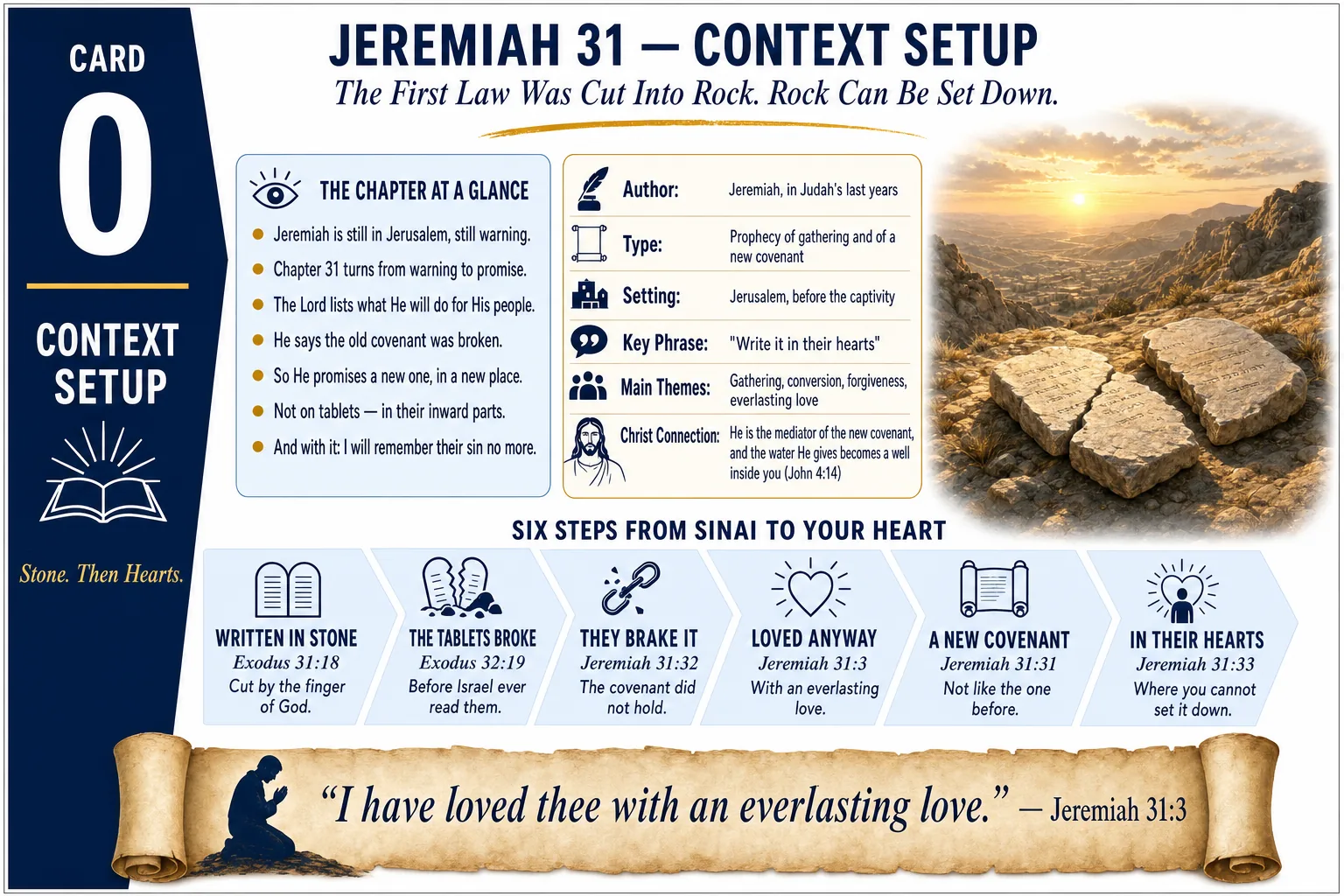
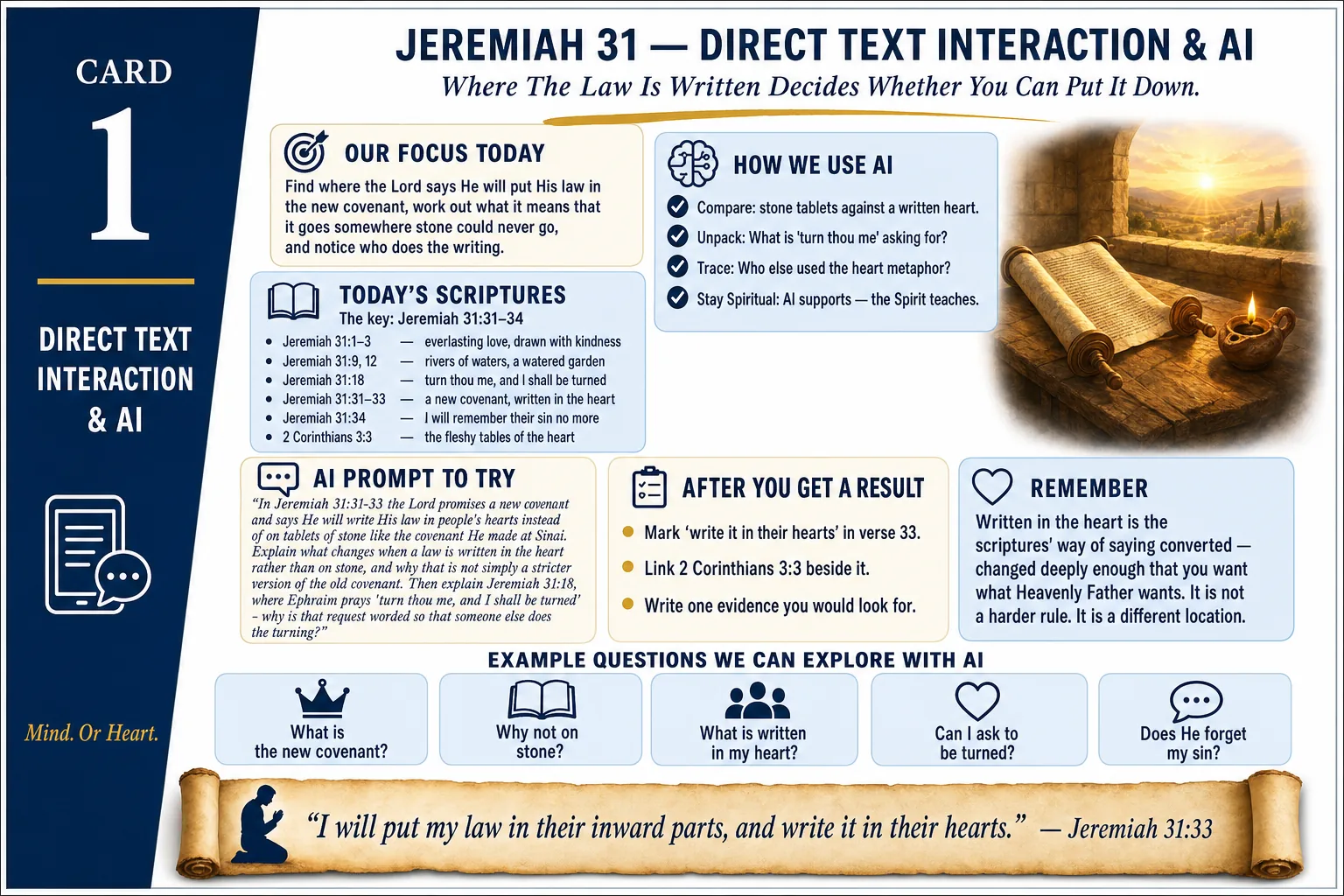
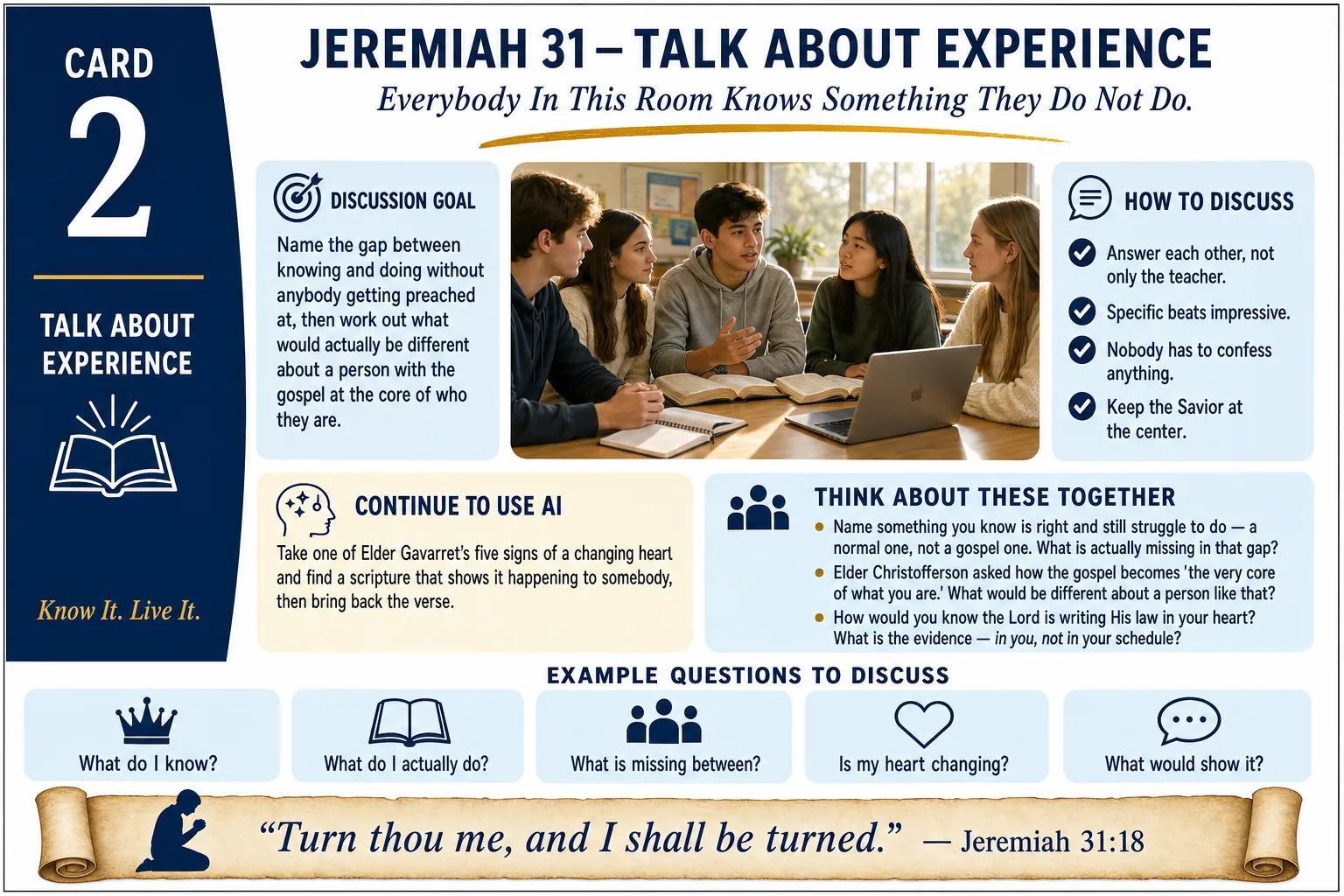
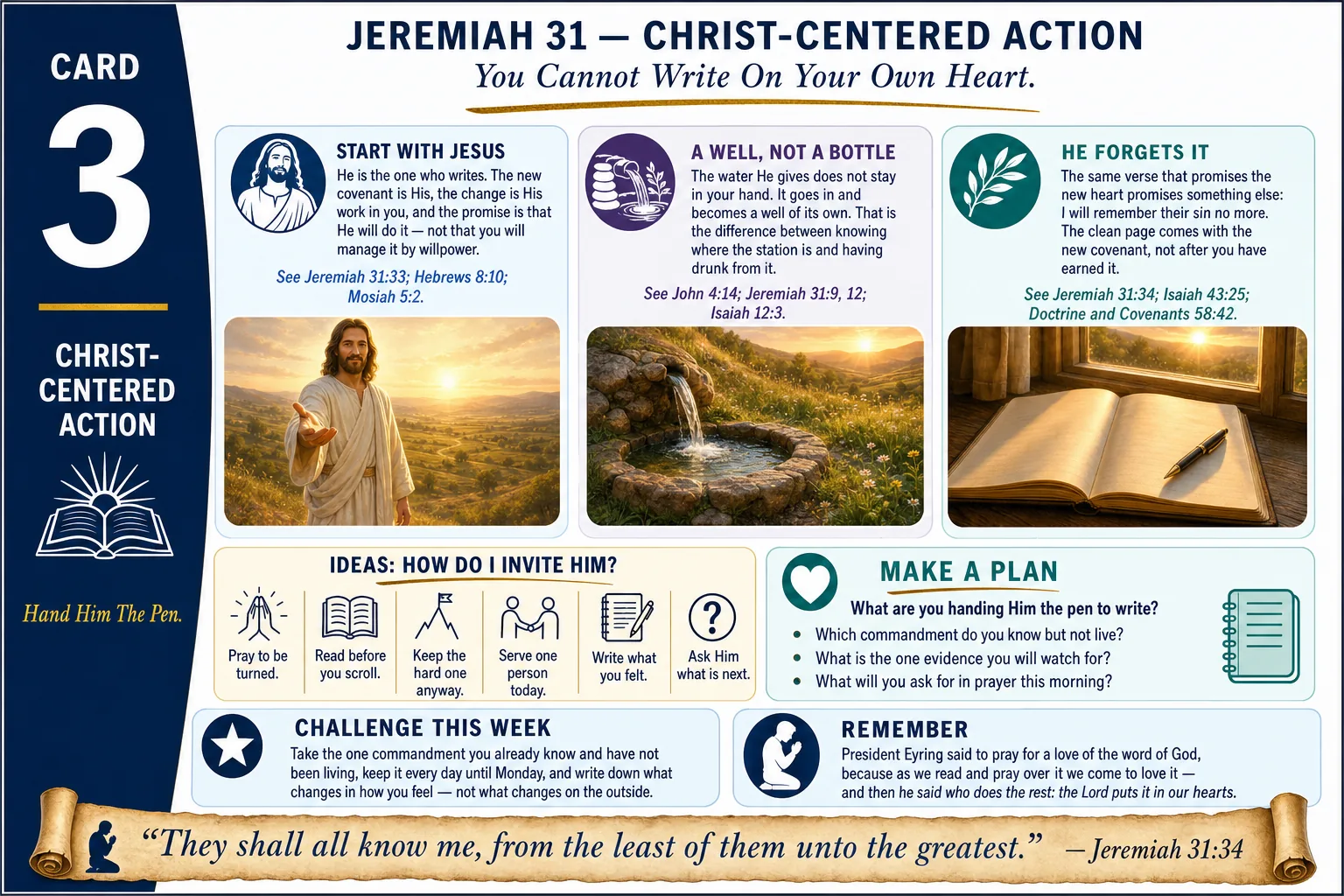
OPEN WITH THE ORDINARY GAP AND KEEP IT SECULAR FOR THE FIRST MINUTE — what is something you know you should do and still struggle to actually do? Sleep, phone, homework, eating. They will answer fast and honestly because nothing is at stake, and that is the point: say plainly that it is normal, that aligning what we do with what we know is hard for everybody, and only then say that the same gap shows up in the gospel. If you lead with the gospel version you will get the polite answers instead of the real ones. ELDER CHRISTOFFERSON IS THE QUESTION THE WHOLE LESSON ANSWERS: 'How can you make the gospel of Jesus Christ not just an influence in your life but the controlling influence and, indeed, the very core of what you are?' ('When Thou Art Converted,' Liahona, May 2004, 11). Write 'the very core of what you are' on the board and leave it up for fifty minutes. STONE FIRST, AND IT IS WORTH THREE MINUTES OF OLD TESTAMENT. The first law was written with the finger of God in stone (Exodus 31:18) and Moses broke it against the mountain before Israel ever read it (Exodus 32:19). Jeremiah 31:32 says the covenant with the fathers was the one 'which my covenant they brake.' So the new covenant is not a stricter version of the old one — it is in a different location. You cannot set your heart down at the bottom of the hill. 2 Corinthians 3:3 is the cross-reference and it is worth marking: Paul calls the Saints an epistle of Christ, 'written not with ink … or in tables of stone, but in the fleshy tables of the heart.' THE GROUP ACTIVITY IS THE MANUAL'S AND IT WORKS: threes, one passage each, report to each other. Jeremiah 31:1–3, 31:6–10, 31:17–20. Then the whole class on 31:31–33 together. Do not read all of chapter 31 aloud; the three passages are a sampler of promises and the chapter is long. WATCH FOR THE WATER VERSES BECAUSE THEY ARE NOT DECORATION THIS YEAR — 31:9, 'I will cause them to walk by the rivers of waters, in a straight way, wherein they shall not stumble,' and 31:12, 'their soul shall be as a watered garden.' If a student finds either one, stop and let the class look at it. THE DEFINITION IS THE HINGE AND THEY WILL GUESS AROUND IT. Written in the heart means converted — changed, wanting to accomplish the will of the Father with your whole heart. Not 'memorised.' Not 'obeying harder.' Mosiah 5:2 and Alma 5:12–14 are the Book of Mormon words for it, a mighty change wrought in the heart, and they are the verses to go to when somebody asks what it would feel like. 'TURN THOU ME, AND I SHALL BE TURNED' — Jeremiah 31:18, and it is the best three seconds in the chapter. The verb is passive. Ephraim does not say 'I will turn myself.' Ask them what it means that the scripture asks to be turned rather than promising to turn, and let them sit in it; this is the difference between the lesson and a pep talk. You cannot write on your own heart. You can hand Him the pen. ELDER GAVARRET'S FIVE SIGNS ARE THE ANSWER TO 'HOW WOULD I KNOW' and the handout has them: wanting to please God in all things; treating others with love and respect; the attributes of Christ becoming part of your character; feeling the guidance of the Spirit more constantly; keeping a commandment that has been hard for you and then continuing to live it ('A Mighty Change of Heart: I Have Nothing More to Give You,' Liahona, May 2022, 23). The fifth is the one teenagers can actually check this week. THE TWO-QUESTION SPLIT IS WORTH RUNNING THE MANUAL'S WAY. Put both on the board — how do I know the Savior's law is written in my heart, and what can I do to invite Him to write it — and let each student pick the one they need. Group by question, prepare an answer for a friend who asked it, then re-mix so each group has somebody from the other question and they teach each other. The handout 'The Savior Will Write His Law in Your Heart' carries the scriptures for both halves; print it. PRESIDENT EYRING IS WHERE THE SECOND QUESTION LANDS: pray for the faith to repent of selfishness, pray for the power to lay aside pride and envy, and pray for a love of the word of God — 'As we read, ponder, and pray over the word of God, we will come to love it. The Lord puts it in our hearts' ('Testimony and Conversion,' Ensign or Liahona, Feb. 2015, 4–5). He puts it there. That sentence is the whole doctrine of the day. DO NOT LET THE LESSON END IN RESOLVE. A class that leaves saying 'I will try harder' has heard the opposite of Jeremiah 31. The ask is a prayer, said this morning, and it is a request to be changed. VERSE 34 IS THE PART THEY NEED MOST AND THE MANUAL DOES NOT DWELL ON IT — the same promise that writes the law says 'I will forgive their iniquity, and I will remember their sin no more.' The new heart comes with a clean page. Say it, because Wednesday is Lamentations and this is the first half of that. THEME LINK, PANEL TWO: he drinks, and it is better than he expected. Knowing the water is up there is the mind; having drunk it is the heart. John 4:14 is the exact image — the water He gives 'shall be in him a well of water springing up into everlasting life.' It goes in and becomes yours. That is the difference between carrying a bottle and having a spring, and it is why the gospel written in the heart cannot be left behind at the bottom of the hill. THE WEEK: today the law is written in you, tomorrow you meet the man who burned the words that do the writing, Wednesday you find out what He does when you break it anyway, Thursday you go to the house where He promised to dwell with you. TIMING: the ordinary gap and Christofferson four minutes, stone and the new covenant six, the definition and 'turn thou me' five, the two-question split and teaching each other ten, close and the prayer ask three, journals at 7:05. If you are behind, cut the 31:6–10 group and keep the split — the split is where they do the work.
Journal prompt
The last five minutes. Card 3 hands into this.
Write down the one commandment you know is right and have not been living — nobody will read this. Beside it write the sentence you are going to pray this morning, in your own words, asking the Lord to turn you rather than promising Him you will try harder. Then write the one piece of evidence you will watch for this week that He is writing His law in your heart, and finish with what it would mean for the gospel to be the very core of what you are.